The Insanity of Taper Mode

IMG_9734

The last three weeks of every marathoners training plan are not only challenging, but also crucial. Taper mode is that point at which your body is fully trained and prepared to go the distance of 26.2 miles long on race day, but your brain does not agree. To complicate this process, your training plan now says that you are supposed to decrease your mileage, rest, eat, and hydrate well in preparation for race day.

This seems to make total sense until you actually reach the point in the training plan where you enter Taper Mode and your brain screams: “Nooooooo. Noooooo. We’re not ready! We can’t do this! We must run more! I am not ready for the start line!”

To which your body responds: “Chill. We got this. We ready. We trained. Now is time to rest and gather our stores of glycogen and other nutrients to be able to perform.”

Yes, you are, in fact ready to race.

Your brain is not going to hear that. Your brain is not going to believe. Taper mode is called “the insanity of taper mode” because this is the point at which even the most psychologically robust completely loses their mind.

You develop OCD. You tell everyone you live in a bubble and to not touch you.

You’re like the llama in the Emperor’s New Groove telling everyone to not touch you.

The last few weeks before a marathon, you are also at your most vulnerable, immune wise. You sanitize everything like an air lock on a spaceship. Then you sanitize it again. You sanitize so much you should buy stock in soap and baby wipes.

Your training plan for Taper Mode says 6 miles. You cheat. You run 8 miles instead.

You panic. You pray. You make deals with both God and the Devil and anyone else who seems like they may be able to help you in any way. Your brain is on full-out psychotic freak out mode because it just realized you are about to run a MARATHON and that is 26.2 miles long. It’s way different from those Netflix marathons you’ve been doing to try to cope with Taper Mode.

All you need to do is make it to the start line healthy and strong. If you can make it to the start line, your body will do the rest. The start line is just as important as the finish line. In order to complete a marathon, you must cross both.

You start reading inspirational quotes, books, blogs, magazines, and watching inspirational movies to try to get yourself over the hump. You start imagining worst-case scenarios. You mentally prepare for this race better than some cult about to eat the pudding before the Hale Bopp comet. Run, walk, crawl, drag, or if in Philly, IN DRAG, you will cross the finish line. You imagine every single possible way and scenario to finish 26.2 miles because your brain does not think you are ready. You break it up into chunks: it’s a 5k with a 23 mile warm up, it’s a 10k with a 20 mile warm up, and any other chunk you can break down.

Meanwhile, your body is relaxed. Your body knows. Every fiber of every muscle in your body has been trained. The imprint of the 500+ miles you have run in the 5 months it took to prepare for the race are ingrained in your muscles. Your body knows what to do.

Your brain needs to get it together.

Calm down, man.

It doesn’t matter if it is your first time, your 20th, or your 50th, Taper Mode always feels this way. For me, I am going for medal # 14. Taper Mode is always the same. Your body is ready, and your brain is completely freaked out. You have followed the training plan, and the training plan has worked 13 times before. You will be fine.

But honestly, the insanity of taper mode makes the marathon that much more beautiful. When you lace up on race day, cross the start line, and get into the rhythm of the race, you will find that moment where your brain finally agrees with your body and calms down: “We got this.” That moment, when everything clicks into place, you just fly like you are on cruise control, and enjoy the moment for which you have spent a significant amount of your year preparing to do. That is the moment of marathon magic.

So while the insanity of taper mode is sure to be annoying and drive everyone crazy, in some ways it is necessary. Being able to appreciate how far you have come and everything you have OVERcome to get to this point is part of the marathon magic. The miracle is that you had the strength, the discipline, and the fortitude to train for those 5 months. This is for the Sunday morning long runs when you would have much rather stayed in bed and listened to the radio, this is for all the times when you ran in the pouring rain because you had to get the miles in, and a treadmill would have been worse punishment than anything mother nature can muster.

To run a marathon, you have to go a little crazy.

“But I’m not ready,” says brain.

“Yes, we are,” says body.

“We will start and we will finish,” says heart.

The Lead of Love

IMG_5458IMG_6088

This is the monthly Feline Friday post on Rewind Real Slow.

“We die containing the richness of lovers and tribes, tastes we have swallowed, bodies we have plunged into and swum up as if rivers of wisdom, characters we have climbed into as if trees, fears we have hidden in as if caves. I wish for all this to be marked on my body when I am dead.” – Michael Ondaatje, The English Patient

About a week after Kitty’s first birthday, Kip walked into our lives. Literally. I had seen this scrappy little orange kitten running around the neighborhood. At the time in the late 90s, Kitty and I had housing, but it was in one of the most drug and crime ridden neighborhoods in a 60-mile radius. I was on my evening walk and saw this little orange kitten on the side of the road, obviously quite hurt. A car had hit him. I tried to find his owners, but no one seemed to claim him or even to care. Not wanting to be accused of cat napping, I talked to him, and he literally followed me home.

So small that he fit inside of a child’s shoebox, I took him to the animal hospital, where he remained for a week. He had a broken arm with permanent nerve damage resulting, as well as severe internal injuries to his side and kidneys. Even after a week in the hospital, he came home with tubing in his side that required me to keep moist and flush with fluids to remove toxins multiple times daily. Due to his size, I had thought he was only a few weeks old. According to dental analysis done by the veterinarian, he was actually 4 months old, his stature diminished by severe malnourishment and neglect.

I already had a Kitty at home, and I did not want to traumatize the orange treasure by renaming him and instituting an identity crisis. I was searching for something close to Kitty (as almost all cats will respond to kitty) that was not kitty; he needed unique nomenclature to fit his persona. I borrowed a name from one of my favorite movies and novels. Kip Quark Anderson had entered our lives.

What I did not realize at the time was how appropriate this name would be to his place and impact upon our lives. Kip was the apple, the joy, and the love of Kitty’s and my life. We had 14 wonderful, beautiful, glorious years together, many of them spent regulating his resulting chronic kidney condition, before he finally succumbed to pancreatitis a few years ago.

Kip was a happy go lucky, playful cat full of joy. He taught Kitty how to not be so uptight, how to relax, how to play. Everyone who met Kip loved him. Kip was leash trained and quite enjoyed walking on a leash, often emulating a dog. He was a frequent visitor to my preschool classroom, where he never failed to delight, entertain, and draw out even the most shy and precarious child in the class.

He handled his chronic health condition with grace and dignity. The nightmare-ish visions of having to “pill a cat” never happened with Kip. I would set his medication on his plate with his breakfast or dinner, and he would happily eat it the same as his food. Towards the end of his life, he was on 5 different medications daily, one of them by dropper, and he never squirmed or protested when it was time for his medications.

Kip kept both Kitty and I from losing our minds. Life was hard in the late 90s and early 2000s, as we faced bad relationships, and sometimes lived in the car. Kip’s attitude was always upbeat and helped to remind Kitty and I of the brighter side of life, that things do in fact, get better. Of all my kids, Kip is probably the one who most taught me how to adult and forced me to create a stability in my life and theirs that I had never experienced as a child. I made sure that he received all the medical care that he required and that I was home to give him his medications on time. I was even able to keep his medication on schedule during my early grad school years when I had a one-way 6-hour plus commute from Central New York to Boston for school.

I had spent my first three years of college as a physics major; The English Patient movie came out my freshman year of college. I was particularly drawn to the character of Kip, as his profession in the novel and movie was exactly what I was studying to do in college. In many ways, Kip the cat fit his namesake. He was proficient in diffusing many tense situations with his absolute love of life and easy-going personality.

What Kip taught me the most in his 14 short years on this planet was love. He taught Kitty too. He taught me that every experience, no matter how dark or dire, has a small sliver of hope. He taught me that every single person we meet in life changes us in ways we may not even see or understand. He lived a very full and very bright life that was nothing but a lead of love to everyone he met.

This month, for #FelineFriday, we honor the memory of Kip. At times in my life when I was trying to go too fast, when I was trying to accelerate at 100mph, Kip always reminded me to slow down and remember the important things. Each experience in our life changes us and stays with us forever. Kip not only led with love, but he has changed my life in ways that will have repercussions until my dying day. Even as I held him in my arms a few years ago, as he passed away, he still taught me in his final breaths, the meaning of love.

Cheers to the memory of Kip this month on Rewind Real Slow. If love could have saved you, you would have lived forever.

The Best Summer

IMG_9497

Despite the still balmy temperatures we have in September, the leaves are starting to turn, the kids have returned to school, and summer is quietly sliding into fall. Summer 2015 is the best summer I have ever had in life. I do not remember a summer like this since 1988. I tried to think about why this is so and to isolate the commonalities that seemingly exist between two so disparate years.

In 1988, I was still a child. This was before I started working at age 14. While my childhood was nothing pretty and everything I have been trying to overcome as an adult, I distinctly remember the summer of 1988 as having a slight respite from the challenges through which I lived in my youth. I remember reading lots of books. I was in Virginia that summer, and the people with whom I was staying had a pool membership. When I was not in the pool, I was next to it reading. Those were the most carefree days of my life. Granted, my tastes have changed. I did not re-read Jurassic Park and all the other Michael Crichton novels this summer, but I actually had time for leisure reading; a rare treat as a grad student.

This summer, I had the gift of time. For the first time in my adult life, I have employment that actually allows me days off. Prior to my current position, I was always working 7 days a week between two or three jobs. The only time I ever got a day off was a holiday. Holidays were not really holidays, they were days to be home and get caught up on school and everything else in the middle of my 60 hour plus survival schedule. My current position gives me at least one day off per week, and often more. I had several days this summer where I had the day off and the freedom to recreate that feeling from 1988 of being free from responsibility and worry. I spent many days this summer at the various parks in the state, on the beaches reading, and doing some light surfing.

Beach days were not relaxing at first. I was so accustomed to the schedule of having to pack school into every free moment due to my work schedule, that my first few beach visits I took my school work with me. Then, as I started to realize my current employment situation allows me privileges I have never before experienced in life, I made a conscious decision that I would not take any schoolwork with me.

That’s where the magic begins.

Beach days became carefree and reminiscent of that childhood summer of 1988. I simply put some food in a cooler, grabbed a towel, a book, and some sunglasses, and off I went. The most “difficult” decision I had to make was which bathing suit to wear, and even that was not hard: wear the dry one that is in the closest reach.

This summer was great because it was probably the first time since I started working at age 14 that I actually had “holidays.” Now I know what the Europeans are talking about. I took off for beach days this summer without school, without work, and without worries. That has never happened for me before.

In some aspects, I feel I was able to reclaim some small portions of my childhood lost due to the difficulties I faced as a child and being forced to grow up way to soon to face them. I felt a little irresponsible “blowing things off” and taking beach days, but in reality, all my work and schoolwork was done, and my bills were paid, so really I was not blowing anything off, I was doing the best thing possible. I was taking care of myself. I was able to experience childhood delight that I never experienced as a child, and able to fully relax and be present in the moment in which I was living. It was one of the best things I have ever done.

As summer slowly changes to fall, I feel I am also losing that feeling. I feel I need to recreate it somehow, so that I do not lose the beauty of my summer beach days. What I am learning, as I rewind real slow, is that peace and relaxation may not necessarily be about your location (although beaches and crashing waves are very helpful), but rather a state of mind that says: “I am here. I am at peace.” Most importantly: “I am enough.”

I have gotten caught up in the whirlwind of fall. The anxiety of back to school (although my grad program runs continuously until its conclusion); it’s that Pavlovian response to the change in season. I find myself trying to jam pack my schedule again.

Then I realized that having the best summer of my life need not be an isolated incident. It is also possible to have the best fall of my life.

Now I’m putting on the breaks.

In the next few weeks, my goal is to refocus myself for a new season not only in weather, but also in life. I am going to remember to enjoy my days off. While I may not be spending them at the beach right now, I need to remember to not fill them with useless and unnecessary things. That beach feeling is something I can recreate in other ways. I just need to figure out how.

Do you get caught up in the fall whirlwind? Is this the time of year you pack your (or your child’s) schedule with activities, meetings, and things to do? Summer is not the only season for relaxing and joy. Fall can have the same feeling of peace if only we know how to find it.

As the breeze blows gently, I am enjoying a fall morning now on my deck with my coffee, and some radio. If this summer has taught me anything, I have learned that it is ok to just sit and be. Doing nothing is not necessarily lazy. Sometimes doing nothing helps to replenish us so that we may fully do something.

What ways are you learning to slow down this fall? Are there things that help you to feel relaxed in the middle of the bustle of back to school and new schedules? Times of transition are often stressful. This is the time when we need to take care of ourselves the most.

Take time to rewind real slow.

36

IMG_9643

36 life lessons from 36 years of camping, running marathons, teaching preschool, and living life.

  1. As we get older, the quality of our friendships is more important than the quantity of them.
  1. Always pee downhill. Not only should you pee downhill, but also not too close to a tree in case some woodland creature decides to exit their home and accidentally gets a shower at the moment you decide to squat.
  1. If a child gives you a rock or some other small treasure, smile, say thank you, and keep it. Children do not have money to buy things. They do not have jobs. The rock/leaf/whatever is probably the only thing they have to give you of value to show that they like you.
  1. No matter how cute they may look, squirrels and chipmunks can be aggressive. This also goes for kittens, puppies, children and other things in small packages.
  1. Always take rain gear, even if there is no rain in the forecast.
  1. No matter which direction the wind is blowing, it will always send campfire smoke in your face, so do yourself a favor and remove your contacts first.
  1. Sneakers melt when kicking logs that are on fire.
  1. Always take time to look at the stars. They remind you of your place in the universe.
  1. A great radio station can totally make your trip.
  1. You can start a good fire with just wood and matches in about 15 minutes. Add empty toilet paper rolls filled with dryer lint, and you can decrease that time to about 5 minutes.
  1. Obtain wood within 50 miles of your campsite to avoid destroying ecosystems by introducing new predators.
  1. Pack light. The bears aren’t going to care if you wear the same pair of shorts two days in a row and it’s less stuff to haul.
  1. Nap time, time outs, and coloring are all for adults.
  1. While the first and last miles of a marathon are very exciting, its what happens in the middle that makes or breaks your race.
  1. Everything you ever wanted to know about yourself, you can learn in 26.2 miles.
  1. Baby wipes solve a lot of problems – even if you don’t have a baby. Keep a pack in the car – you will be amazed at what you use them for.
  1. The best friends are the ones with whom you can go days without talking to them, and then when you do reconnect, able to pick up exactly where you left off.
  1. If someone fails to communicate with you, and then accuses you of making a bad decision, it is not your fault! You made the best choice you could on the information available, and if the other party properly communicated, you would have made a better choice. Don’t beat yourself up for doing the best with what you have.
  1. Do not live like you are dying. We are all dying every day. Live like it is the first day of your life. You will not be this old or this young again.
  1. Always take time for your grandparents and those older than you. You may have “all the time in the world,” but they do not. Let them know how you feel before they are gone and remember that the greatest gift you can give is your time.
  1. Always ask before touching someone. Always. This goes for children, animals, pregnant women, senior citizens, everyone.
  1. The best times in your life are the moments where you were too busy to take a photo, post a status update, or write something down about it.
  1. “Please” and “thank you” never go out of style. They are timeless. Use them.
  1. If you always tell the truth, you don’t have to remember or worry about lies.
  1. At the end of the day, what matters most is that you are able to sleep at night, content in that your words and actions for the day were your best effort.
  1. It is okay to say “no.”
  1. Take time for you. You cannot pour juice from an empty pitcher. Refill your cup, and when it overflows, you are able to give.
  1. Batting averages are based on best 3 of 4. You don’t have to be perfect to be great.
  1. You may spend 40 hours a week working, but what you do with the other hours of your life is up to you.
  1. It is okay to distance yourself from toxic people, relationships, and situations.
  1. It is okay to sit and do nothing every once in awhile. Really.
  1. Run like you are 6 years old again. Rediscover joy.
  1. If you adopt a pet, remember that this is a commitment for life. Your pet may live for 18-20 years. It is like having a child. Are you ready for that type of responsibility? Do not be flippant with this decision.
  1. If you decide to downsize or minimize, you will not miss or remember the things you get rid of. There is too much clutter in our houses and lives. Let it go.
  1. If you love someone, tell them. Tell them before it’s too late. Tell them because people are not mind readers and they may not know. Tell them. Even if it is not reciprocated, it is important for people to know that they are valued.
  1. Always be thankful for something. Every single day, no matter how small, find a piece of gratitude in every day. Life is too short to be miserable.

Finding Peace

DSCN1930

Every year for the past 15 or so years, I take a camping trip for Labor Day weekend. I go completely off the grid to a remote location that has no cell service, no electricity, and no running water. I joke that I have to drive myself to the middle of nowhere to escape my life. The sad part is that it is true.

Part of my journey in simplicity and minimalism is to slow down in my normal, every day life in order to create a life I don’t need to escape. I am hoping to be able to identify pockets of peace in my daily routine so that I do not feel I need to wait for that one, magical time of year for it all to happen.

My camping trip has always been an escape from technology, phones, email, responsibility, problems, my 2 or 3 jobs, and whatever other drama was occurring in my life at the time. Oftentimes, I was so stressed out that I was unable to truly relax, even though I was completely displaced from the stress and in a very beautiful place.

This year, I am hoping that my vacation is a true respite. Each year I return to the same location, no matter what is happening in my life, or what my point of origin. This year, I have so much to be thankful for. Instead of having to worry about paying bills, putting food on the table, or rushing from one job to the next on 4 or 5 hours of sleep, I am thankful that I am finally at a point in my life that I have employment I enjoy, that treats me well, and meets my basic needs.

This is the time of year when I push the reset button and recharge. My goal in slowing down my every day life is to be able to do this in small doses daily, without feeling the need for one huge trip. I will continue to do my camping trip every year, but I am hoping to bring some of that peace to my life daily instead of just annually.

Part of my trip this year is going to be identifying areas of my life in which I can slow down even more. This is a gradual process where I am continually evaluating my priorities and making changes in my life. I don’t feel that there will ever be a point in my life where everything is 100% okay, happy, and stress free every day. Unless you’re on botox or some really good pills, I don’t think that happens for anyone. My hope is to increase my happiness as much as possible.

For me, I find that I attach more easily to places than I do to people. I frequently revisit places that make me feel good. Being able to identify what makes you feel good is helpful in being able to achieve peace and identify what you can do in your daily life to recreate that feeling.

What do you do to feel peaceful? For some people, it is the little things in every day life like a bubble bath, or reading a good book. Sometimes it is having a cup of coffee with a good friend. Part of my goal on my big peace trip this year is to identify more of the small things that bring me peace on a daily basis.

Finding peace is helpful in grounding oneself so that you have an anchor in the storms of life. I have some pretty big life changes coming up, and I want to be sure that my foundations are strong in order to weather those changes. Sometimes you need a moment to regroup and remember why you are doing what you are doing and what is important.

Family, experiences, and love are the important things in life. How can we maximize those positives? Sometimes when you are in a situation, you are so in it, that you need to take a step back to make a decision. Being able to look objectively at life helps you to identify the positives and negatives to work more efficiently towards your goal.

One of the most peaceful aspects of my trip each year is when I sit by the water and the wildlife comes right up to me. I wake up in the morning to the sunrise and the sounds of birds. Not only birds, but ducks. Quite a few years, I have woken up to quaking, unzipped the window in my tent to find a duck looking at me. Being able to reconnect with nature is a great way of centering.

Each year at the holidays, I usually give people a colorful miniature rubber ducky with their holiday card. This causes some confusion, but for those who know about my camping trips, they know that it is the time of year that is most peaceful for me. Holidays are not supposed to be about gifts, they are supposed to be about people, experiences, and peace. I give those duckies each year as a reminder to people to be peaceful, as the ducks remind me of the time of year in which I experience the most peace. It is one of the small ways I have found to recreate that peace I feel on my camping trip each year.

How do you find peace? Do you need to take time to step back and recenter? If you are constantly going from one thing to another, it may be time to slow down and regroup. You cannot give from an empty cup. Stop and recharge.

Rewind real slow.

Hey, Jude

IMG_9236

Here is the newest installment in the monthly #FelineFriday series.

How my third and youngest son took a sad song and made it better.

My 3 year old is in charge. When Kip passed away from a chronic illness at age 14, it left just Kitty and I. Again. I always called Kip and Kitty the dynamic duo. They grew up together. Kitty and I were alone the first year; then Kip had arrived shortly after Kitty’s first birthday. So after Kip passed away, Kitty and I were alone. I was okay with that.

Kitty was not. He needed a companion. We spend a lot of time together. We grieved together. As time went on, I noticed that instead of getting better, Kitty actually got worse. He was clingier and his anxiety levels seemed to increase when I left the house. He needed a companion.

I spent some time searching for the perfect companion for him. Being that Kitty is an older cat in his teens, I did not want to bring in some young punk that was going to push him around. I also knew that neither one of us has the tolerance to be able to survive kitten phase again. We needed a young adult with an easy-going personality.

I searched four local shelters talking to staff about cats and their personalities trying to find someone who would fit into our family. When I adopt, I adopt for life, so I wanted it to be a positive situation for everyone. I was not going to adopt and return or rehome if it did not work out. It needed to work out.

I had pretty much given up hope, thinking that the cat that would be the perfect match to join our family just wasn’t out there yet, but that it would happen in time. Quite a few people in my social circle knew I was looking to adopt. Then, one of them called me and said, “I’ve found the cat you want.” He was in a shelter about 2 hours away from where we live.

I called the shelter on a showy Valentine’s Day to inquire. I explained Kitty and my situation to the shelter manager, who seemed to think that the cat in general would be a good fit. We were in the middle of a central New York snowstorm. Both schools and my work were closed for the day. But, the plows had been out, the roads appeared clear, and I decided to make the 2-hour drive north to visit with our potential new family member.

Once I arrived, I spent a few hours at the shelter visiting with our potential new family member and talking with staff that had interacted with him. I learned of his background as a stray that had been taken from a hoarding situation that involved over 30 cats in a singlewide trailer. I talked to the shelter animal trainers about how he interacted with other cats in playgroups and socialization times.

We found our family member. Jude Raymond Anderson came home on February 14, 2014. He was 2 years old at the time.

I did the slow introduction method where I had Jude in a separate bedroom for about a week before I introduced him to Kitty. It did not go as planned. They had some accidental meetings. They were positive. They each knew the other was there and would put a paw under the door. Jude escaped. Kitty tried to enter Jude’s room. The introduction was not as gradual as it was supposed to be, but it was positive. There was no hissing or fighting involved.

Sometimes I am skeptical about their relationship. Jude is young and playful. Kitty will play with him to a point, but then gets tired, probably due to age, and seems irked that Jude continues to pursue him. Yet there are also times when they lick each other. I am pretty sure they are friends. Kitty’s anxiety level is almost non-existent now that he has a companion.

Jude is a joy in our household. He definitely keeps both Kitty and I on our toes. I am glad we did not get a kitten. It is challenging enough trying to keep up with a 3 year old. We play every day. He runs around the house. Jude is pretty good about settling down at night, though. He even sleeps with us sometimes.

By the way, Jude is the boy name I had picked out for a human child. Given that I am unable to have children, Jude is actually the first of my fur-babies to have a name I had reserved for a human child. It took a lot for me to do that. I think that when you are told you cannot have children that there is always some part of you that holds out hope that they are wrong. Giving Jude the name I had chosen for a human son was a big step for me in being able to accept my life, flaws and all. I love him like a son. I truly do. I have now raised 3 boys. Yes, they may have 4 paws and a tail, but they are all each very much my sons.

Jude entered a time in our lives when Kitty and I were perhaps the saddest we have ever been. We have a very different dynamic in our house with a 3 year old. I would not change it for the world. He has brought life and love to our house. In the true meaning of the Beatles tune after which he is named, Jude has indeed taken a sad song and made it better.

Hey, Jude. We love you.

#TBT #Occupy

IMG_1250IMG_1039IMG_1037IMG_1025

By request, this month’s TBT post tells about the three months I spent with the Occupy movement in five different American cities.

“It ain’t a middle finger on a t-shirt, the establishment’s tryin’ to sell.

It’s a guy with the balls who told the establishment to go to hell.” – Eric Church

Slam Poetry Intro:

If a movement were to embody the battle cry of the disenfranchised, overworked, and generally shit-on Generation X, it would be #Occupy. We are the first generation in the history of this country to be worse off than our parents. Saddled with ever growing mounds of student loan debt that we were encouraged to incur in the futile pursuit of the American Dream, we are slaves not only to our debt, but to the boomers, our parents, as they age and look to us to care for them. At the same time, we struggle to provide for our own children and have the lowest rates of home ownership of any generation.

We grew up in the 80s, the era of Reagan and trickle down economics. Let me tell you that from the view of the 99%, the only trickle down that has worked have been the piss and filth in which we squander as the result of the establishment choking us to the point of death and then continuing to squeeze. It makes Urinetown look not like a musical, but rather like a pristine, and sterile hospital. We were raised in the age of excess, where more equaled prestige, and when it came our turn to take the reins, encountered a Second Depression that the right likes to write off as “recession.”

We break our backs under the lie of meritocracy. If good deeds equaled rewards, then why are we on our knees, as we beg for rights like healthcare, housing, and employment? We are the generation that fought your war on terror, and yet our veterans come home to shambles worse home than abroad. As a country, we neglect those who have fought to protect our freedoms, often in a war that they did not support or understand.

In all five American cities in which I occupied, encampments held relatively the same type of folk. Generation X. The students, the veterans, the homeless, the gay, the everyday people whose blood, sweat and tears keep this country moving every day.

End Slam Poetry Intro

One of the things that amazed me the most about the time I spent with Occupy was how human we all were in our connectedness to the issues and the situation. There were people in Philly, Boston, New York, and the two other cities in which I occupied that were of all ages, colors, and religions, and were able to create a harmonious and unified community, the type of which some cities dream to create. For the most part peaceful (yes, I understand some cities had violence), it was an opportunity not only to try to have our voices heard, but to come together and share the common experiences we all had.

One of the most important things I learned from my time with the Occupy movement is that the notion of meritocracy in this country truly is dead. I have often wondered both in my personal life and as a social worker, how it is possible for people to make “good choices”: for people to be working and live in small apartments with practically no luxuries, such as no cable, no cell phone, and sometimes no vehicle, and yet still struggle to put food on the table. The problem is not that we are not working hard enough or making poor choices. The problem is that our time is not valued and wages have stagnated in comparison to inflation.

Combine the death of meritocracy with the growth of the upper class, and now there is this entire swarm of people who made up Occupy. One of the things I feel like I brought to the table in my interactions with my fellow occupiers was the realization that in some European countries, such as France, where things are very different: France has universal healthcare, ample vacation time, ample pay, and other amenities than American lack – is that in France, the government is afraid of the people. In America, the people are afraid of the government.

This is an important distinction to consider. The power of the occupy movement was in realizing that we are the 99%. While the 1% holds the power in the form of an oligarchy, we are in fact more numerous and potentially have the ability to take some of that power back. The hard part is organization.

Once the camps disbanded, we all returned to our lives. We are still slaves to our jobs, taking care of both parents and kids, and living in tiny apartments because we can’t afford houses. We can’t afford healthcare. We can’t afford vacations. We see what “normal” lives are on the media and drown ourselves even further by going into debt trying to achieve what the 1% has gotten by pushing us down.

Part of my journey into minimalism is to further embody the occupy movement in my own life by saying no more. I will not be a slave to 65-hour workweeks. I will live within my means. If I have a pair of $7 jeans from Goodwill that fit and are decent, I do not need to go out and buy a $60 pair of jeans from designer store. Who am I trying to impress? People will either like me as is or bug off. I refuse to buy into the lie that the 1% is selling.

I am fully aware that I have lived through this country’s Second Great Depression in what was supposed to be the highlight years of my life. I am fully aware that I will never be able to afford to purchase a home, or have children. At this point, I have finally realized that no matter if you work hard and make good choices, that the system is stacked against us, and that it is a system that has been decades in the making.

It is perhaps times like this, when I feel closest to people who were from my grandparents’ time the people who lived through the first Great Depression. They were able to survive hard times and yet still maintain their dignity and their happiness. My time with the occupy movement has taught me the same. I may not be able to enact widespread change of the clusterfuck around me, but I can work to enact positive change in my own life. I can strive for happiness.

Yes, I am buried in student loans that I will never be able to repay, and I do realize that education was my “choice” (but really, what jobs can you get without one?); I am not paid a salary commensurate with my educational level, but I make a living wage. I may be on a shoestring, but I make ends meet. I have people in my life that love me, and at the end of the day, that’s all that really matters.

For the record, I would have to say that of five cities, Philly was my favorite camp in which I occupied. In Philly, there was a sense of community. People were respectful and helpful with advice, warmth, and coffee, anything that you needed. The people I met and spent time with in the occupy camps would literally give you the shirt off their back if you needed one. That is what life is all about. Life is about people, not things.

While occupy is a political movement, and holds deeply political meanings for me, the most important aspect of my experience was very human. It’s about knowing that you are not alone in this world, that someone else shares your experience, and that you are loved.

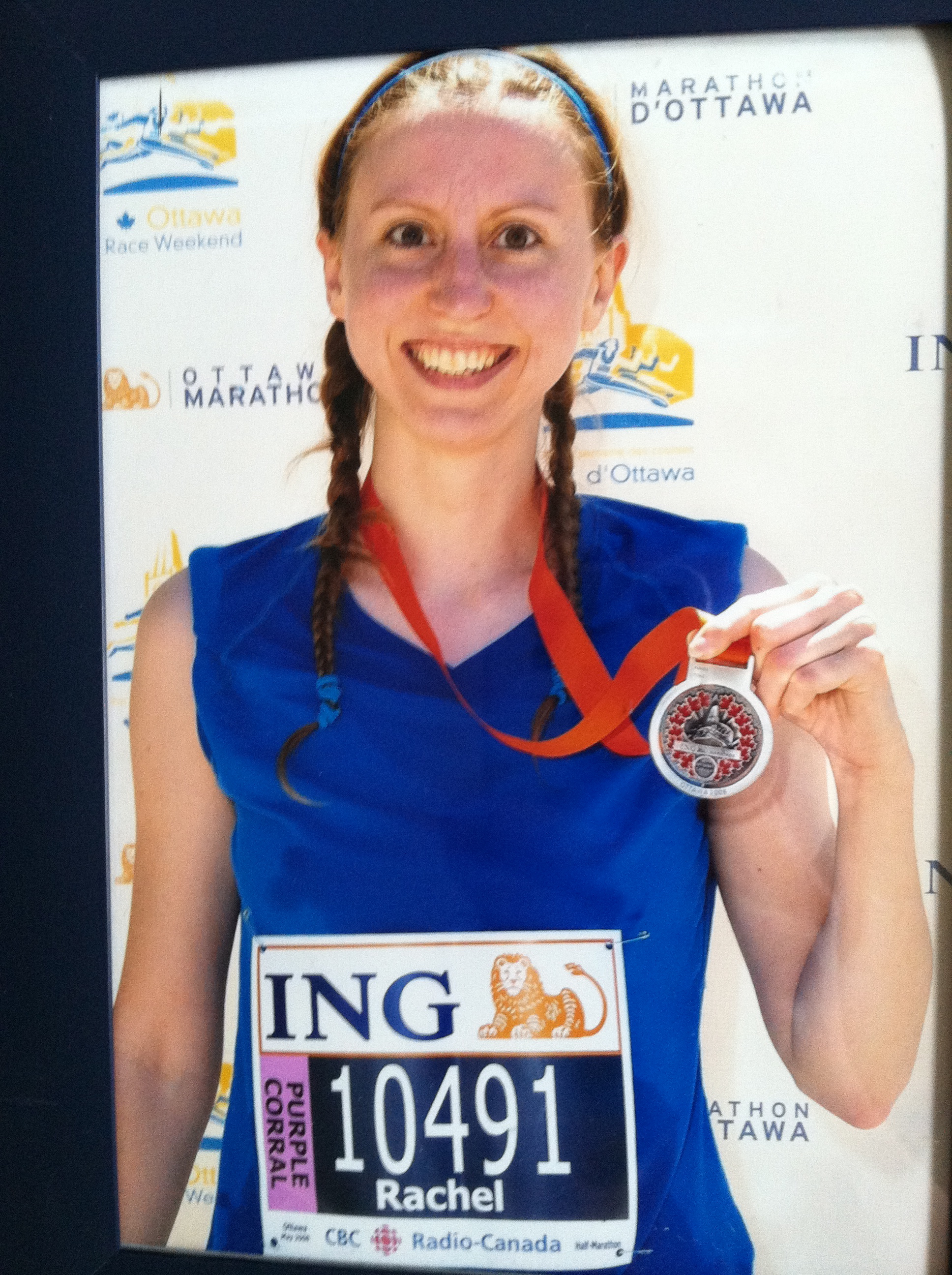
My name is Rachel Anderson, and I am the 99%.

The first mile

IMG_4083

The first mile lies.

The last mile does too.

When you’re running a marathon, the first 26 miles is easy. It’s that last .2 that kills you.

This is about the first mile, in running, and in life.

The joke is that you don’t ever want to spectate in the first mile of a marathon. After spending an hour or more in the corral waiting for the shot gun start and the waves to cross the line, we all have to pee. Marathon runners in a sanctioned event generally go where we want to go without penalty or repercussion. The misconception is that we have to go in the first mile. In my experience of running 13 races, this is not true. We often spend the first mile jostling each other, trying to break away from the crowd, settle into pace, and avoid colliding with people slower than us without being run over by those who are faster.

The first mile is a hot mess, and the last thing on anyone’s mind is stopping to pee.

We just want to get the heck out of the pack.

The first mile of any life event is the same. When you start something new, you have to avoid going out too fast so that you do not lose steam, and you have to avoid standing still before the opportunity passes you by. Beginnings are hard. Running marathons has taught me to not only embrace finish lines and the accomplishment they bring, but to also appreciate the opportunities that start lines and new beginnings bring.

One of the hard parts of the first mile is finding your pace or settling into your rhythm. Depending on how large the race, I like the really big ones with 20,000+ runners; sometimes it takes to mile 5 or 6 before you actually settle into your pace. I call it cruising altitude. Kind of like an airplane, it is the point in the race in which I just go, my body doing what I have spent the past 5 months training it to do, and my mind just enjoying the euphoria that is the feeling of the race and riding on the energy of the cheering crowds.

It takes guts to put your self out there like that. 26.2 miles – what could possibly go wrong? You put 5 months of your life into training for one day. One day that you don’t even know what the weather conditions will be like for an outdoor event, if you will be sick or well, or any other technicality or detail, other than you have signed up to toe the line to run 26.2 miles that day. It’s been circled on the calendar, sometimes for a year in advance, depending on the race for which you registered, and so many hopes and dreams hinge upon that date.

Did you adequately train? Did you adequately hydrate? Are you really ready to toe the line? All the doubts and insecurities that you have well up inside you as you spend that hour or more in the corral waiting for the start.

The first mile lies.

The first mile says: why am I here? What did I get myself into? What if I fall? What if I do not finish? What if I fail?

That moment when you hit cruise control is when faith kicks in. That is the moment when you realize you have trained, you are ready, and you are now entering cruising altitude in giddy anticipation of the finish line.

But what about that first mile? How do you get through that?

It’s scary. Trying anything new is scary. Whether it is a new job, a new relationship, letting your walls down and allowing yourself to be vulnerable with someone, anything new is scary. The first mile lies.

I don’t know what to tell you other than that. The person who starts a marathon is not the same person who finishes a marathon. Everything you ever wanted to know about yourself, you will learn in 26.2 miles. The first mile lies. While it may not seem possible the moment you are in that first mile, once you are past it, you will know that you can get through it and will have this feeling of invincibility that will never leave you.

Beginnings are hard. I’m not sure how to make them easier, but I know that it is possible to get through them. Most times, the best things in life are just on the other side of fear.

I would rather be a “did not finish” than a “did not start.” Even a “last place finish” is better than a “did not start.”

There are times in my life when I am facing new beginnings that have absolutely nothing to do with running. I try something new, I feel needy, clingy, insecure. That’s the equivalent of the first mile. Yet, somehow, those negative feelings always pass and things work out all right. If running has taught me anything, it’s to keep going because the best sight may be just around the next corner.

As I slow down in life and try new things, I have to learn to be comfortable with those challenging feelings that sometimes come with new experiences. It is hard to sit there with those feelings. Insecurity and doubt are not pretty. I know that it is all about finding the balance between going out too fast and standing still. I can tell you right now, that I am not the type of person to stand still.

While the first mile may be challenging, it is definitely worth it. Once you get over the initial hurdle and settle into your race pace, everything works out fine. You are able to enjoy the race, the crowd, and the experience for which you have given a significant portion of your year and life to have.

The first mile may lie, but once you get past the fear, you have one of the best experiences in your life.

What new things have you jumped into lately?

Good riddance to bad karma

IMG_0708

In my efforts to purge, downsize, simplify and minimize, perhaps the most difficult objects to make decisions about are those with sentimental value. I am definitely not one of those minimalists that have blank, white walls and only a certain number of items in my home. My goal in simplifying and minimizing is to have more time and space in my life for what is most important and to only be surrounded by people, things, and experiences that I love.

If I have fewer things, I spend less time cleaning, and more time engaged in activities with family and friends that I love. If I have less things, and someone spontaneously says, let’s pack a bag and go to Europe (wishful thinking, but just saying), my response would be an avid “yes” with no hesitation, as I would not have to worry about a bunch of stuff holding me down.

While some of my early years in life were very challenging bouncing around trying to get an education and housing, I have to say that they were the most freeing times of my life. There is freedom in the fact that I hitch hiked the west coast in the 90s with only a backpack. While I am much more settled now and have all the accoutrements needed in a household, having only what I absolutely need and love in my life enables me to regain some sense of that feeling of freedom.

It is very easy to go through the house and purge items that are multiples of each other. Did you get married recently and end up with three blenders? Even if you are the green smoothie queen, I hardly doubt you run all three at the same time. Most people can get by with one. Do I really need 37 coffee mugs? Yes, 37 coffee mugs. I recently took them all out of the cupboard and counted them. That’s a mug for every day of the month without doing dishes. Who doesn’t do dishes? I kept my 6 favorites and donated the rest.

I really won’t go there (yet) when it comes to sentimental items like that jean jacket you wore to high school football games or a copy of your graduation announcement, but when it comes to items with bad karma, it’s time to let it go.

Sometimes we hang on to things not because they are functional or useful, but because they evoke certain emotions and memories when we look at them. If those are happy times, then okay, but if not: let it go.

Some bad karma items to which I recently said good riddance and could not be happier about it include:

  • A dress I wore last fall to the apple orchard with someone who I was dating, and the relationship ended very poorly. Every time I looked at the dress, I would remember the apple orchard day, and I haven’t worn it since.
  • The travel mug that was in my backpack when I hitch hiked both the west and east coasts. It was my only “dish” and I drank and ate everything out of it. I don’t need to be reminded every day of how hard life used to be. I am where I am right now and right now, I have bowls and plates and glasses.
  • The strappy heels I wore to a wedding, which spent their time on the dance floor by themselves under a table because they were so uncomfortable, I spent more time barefoot than I did wearing them.
  • The blanket that was a wedding present 15 years ago. I have since divorced, and I have many other blankets. I do not need that one to remind me of a failed marriage. I have learned from my experience and moved on.
  • Cigarette. I quit smoking years ago, but have always kept a pack in my center console “just in case.” I haven’t touched them in years. I don’t need the reminder. My life is different now. I threw them away.

Sometimes when you look at something, it brings up memories that are painful, or reminds you of a time that was really challenging for you. Those are the things you need to kick to the curb and let go. Do not let baggage bring you down. If it is not purposeful, serving you in some way, or actively contributing to your current happiness, then it is time to say goodbye to bad karma.

Some items are there to remind you of challenges you have overcome or survived, like the cigarettes I had in my console. I don’t need them to remind myself that I was able to quit smoking. I have 13 marathon medals that prove I quit smoking and live a healthier life.

Bad karma can be hard to identify sometimes. It could be something you use everyday “just because.” Evaluate the items in your life to be sure that they are either useful or bring you joy. Life is too short to hang onto reminders of miserable times.

Finally, it is also important to remember that it is not just things that can produce bad karma. Toxic relationships and people, bad habits, negative reinforcing behaviors are all things we need to break up with. I recently went off the grid and kicked my face book account to the curb because it was making me sad. I stopped making the effort to talk to, call, and text people who never take the initiative to talk to, call or text me. Relationships are a two-way street. If you are the only one doing the work, it may be time to engage in some self-care and disengage from people who either don’t care or give you nothing in return. I am now having higher quality interactions with the people I want to have in my life.

Is there a bad habit you want to give up? Quit smoking or engage in healthier activities? Do it. Say goodbye to bad karma and make changes in your life. Don’t wait for New Year’s or the first of the month. You get one life. The time is now.

Say good riddance to bad karma and dissociate from the things in life that harm you. If it is not helping you, serving a purpose, or bringing you joy, it is time to let go. Life is way too short to hang onto that which brings you down.

What bad karma items, people or habits in your life can you kick to the curb?

Gratitude

IMG_9157

There is a Buddhist saying that to live in the future creates anxiety, to live in the past creates depression, and to live in the present creates peace. While I agree with this wholeheartedly, I also think that to live in the present is a form of privilege.

When I was working on my social work degree, we participated in this project called “Walk A Mile,” in which we spent the afternoon attempting to live out a scenario given to us that was supposed to emulate the day in the life of a person in poverty. We were given toys dolls for children, told when the work hours were, had to juggle childcare, paying for bills, and emergencies like trying to get to food pantries and avoid utilities from being shut off. Little did the administrators know that when I was participating in this simulation, I was homeless myself, and have a history of homelessness from the time I was very young. At the end of the day, my classmates were able to return to their plush condos and lives in which every need was met, while I spent the night on the street, trying to find a safe place to sleep.

This exercise was designed not only to give insight to the future social worker into the lives of those with whom we would work, but also to establish a feeling of gratitude. There are many different forms of privilege in this world. Being able to remain present is a byproduct of economic privilege. During the simulation and in my personal real life experiences, when you are living paycheck to paycheck unsure of where your next meal is coming from, it is hard to stay present. You are always looking to the future for the next best thing that is going to help you escape the cycle of poverty, or you are simply reacting to what happens around you because you are too overwhelmed to handle anything else. It creates a lot of anxiety.

In my slowdown, I have come to realize that being present is a point of privilege. It is a privilege borne out of economic prosperity. When you do not have to worry about where you are sleeping for the night or how you are getting to work in the morning, you have the leisure to enjoy the moment you are experiencing.

Given this, I have also come to realize that it was in those times when my life was most challenging that I was also the most grateful for the smallest things. I recently came across a gratitude journal that I had kept during my early college years. There were days when I listed being happy that the paper I had written came off the printer warm because it was so cold outside and my hands were frozen from being inadequately dressed for the weather.

I have also seen posts online during the holiday season where people will do a “gratitude challenge.” Post everyday why you are grateful! Don’t just celebrate Thanksgiving for one day; celebrate for the entire season! What happens in the spring and summer when the holidays are over, the living is easy, and the weather is warm? Do we forget to be grateful?

We need to be grateful every day.

Let me say that again. We need to be grateful. Every. Day.

Just as I was able to be thankful for warm printer paper during some of the more challenging times in my life, I need to be just as thankful in the good times in my life.

The way my life is right now, I have never had it this good.

Expressing gratitude allows us to be present because it causes you to pause and reflect on the now. To really slow down, we must look at where we are and appreciate how far we have come. If you are constantly looking in the rearview mirror or wondering what is around the next curve, you are missing the most beautiful things that are right in front of your face. When the Buddhists say that to be present brings peace, they aren’t kidding.

I need to get back in the habit of keeping a gratitude journal in which I am able to identify at least one thing per day for which I am thankful. Even if you are having a “bad” day, there is always something for which to be thankful, no matter how small. Even the days when I was simply thankful that I had enough fare to ride the bus instead of walk in the cold.

To start, I have many things to be grateful for right now:

  • Health. Without health, we are nothing. Literally. If you do not have health, you are dead, and that is the absence of life. After many potentially fatal experiences in my life, including lymphoma, multiple anaphylactic food allergies, and other accidents, I can genuinely say that I am happy to be alive. Celebrate your health and the ability to grow old; it is a privilege denied to many.
  • Housing. After many years with precarious housing (including growing up – a time when I had even less control of my life), I am thankful that I have had stable housing for the past 6-8 years.
  • Food. Do you know what it is like to be able to go to the grocery store and be able to get everything on your list? Let me rephrase that: do you know what it is like to go to the grocery store and have to make difficult choices picking and choosing what is on your list because you have a very limited amount of funds and have to chose between groceries and paying the light bill? I am thankful that the past few months, I can go to the grocery store and get everything on my list without having to choose between, say bread or cereal.
  • Friends. I have good people in my life. When the Wonderful Life movie says that no man is poor who has friends, they are right. I am privileged to now have time that I have not had before to be able to cultivate the friendships in my life.
  • Family. My family may be small, but without it, I would be nothing. Having family has forced me to find stability in my life as an adult that I did not have as a child. It has forced me to grow up and to evaluate what is really important in life.
  • Education. My education has enabled me to escape the cycle of poverty. It has given me the tools to be able to find employment that allows me to meet all my basic needs.
  • Opportunity. I am so thankful that I have finally found employment that I not only enjoy, but that treats me well, and gives me the opportunity to slow my life down and enjoy the moment in which I find myself. I have never felt so alive. Having the opportunity at this point in my life to be happy – truly happy – is such a gift.

To be grateful is to take the time to pause and be in the present. To be in the present means to find and be at peace. If you are finding yourself hurried and wondering, “where did the summer go?” on this first day of August, then it may be time to slow down and identify your points of gratitude.

That anxiety you feel is what happens when you are so focused on the future that you do not enjoy the now. That depression you are feeling is when you are so trapped in the past that you are unable to move forward. Be thankful. Get out of the rut and be present here and now.

For what are you grateful?