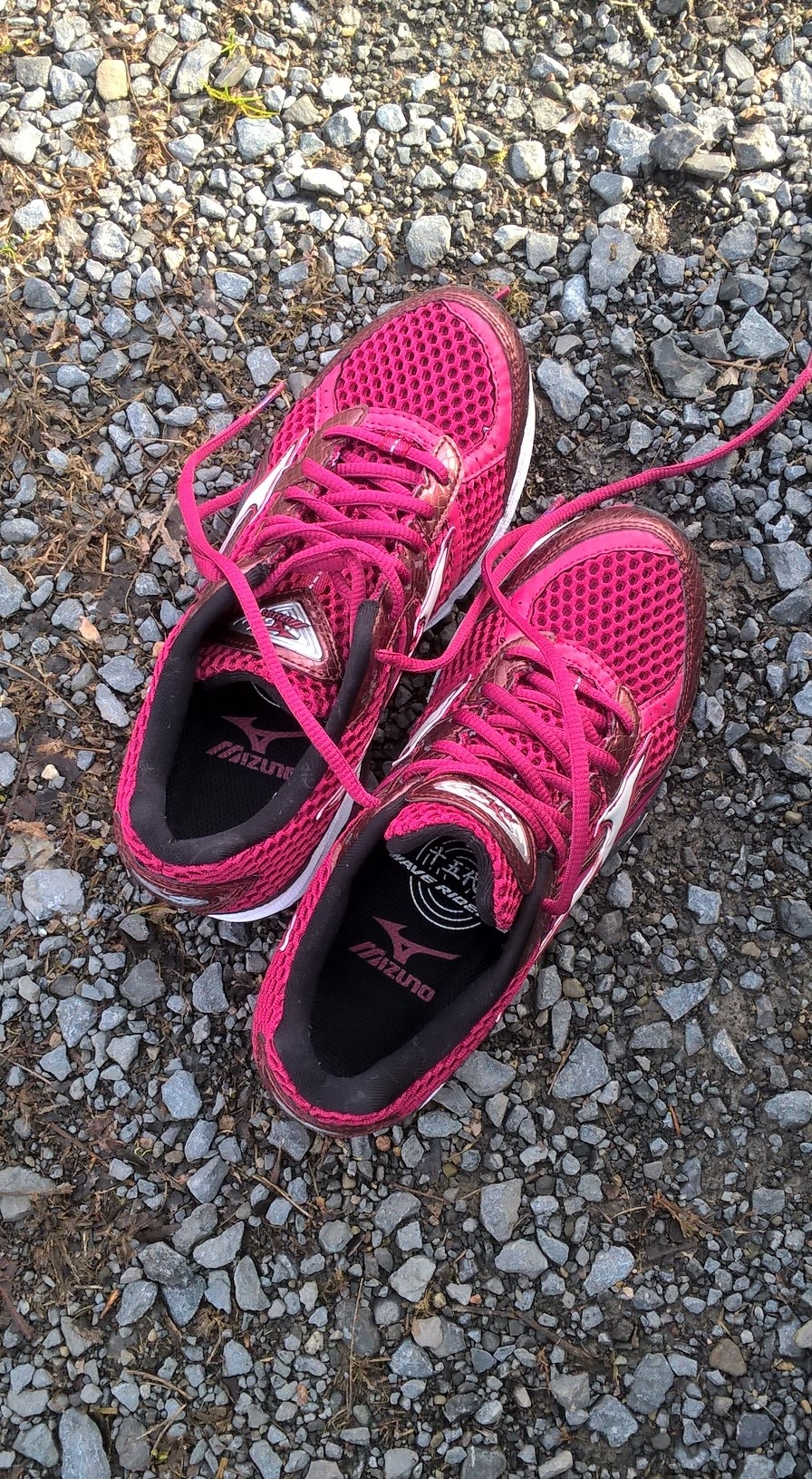
Look who is off the injury list with a 2-mile trail run! It was a balmy 39 degrees as I laced up my second pair of Mizuno Wave Rider limited edition model 15s today. I was very fortunate that in my first run back after my last marathon in which I tore muscles in my right hip that I was able to run comfortably without pain today.
I was very fortunate in this injury in that I received stellar medical care and was able to have the luxury of listening to my body completely in regards to what it needed to heal. My massage therapist introduced me to Thai massage to help with this injury, and I highly recommend Thai massage not only for injuries but also for routine maintenance. While I have traditionally received Swedish massage, now that I have experienced Thai, I do not want anything else. Apparently, if you go to the hospital with an illness or injury in Thailand, hospitals provide this type of massage as medical care. After having 4 sessions to aid in the recovery of a torn muscle, I completely understand why this is medical care.
Now that I am off the injury list, I am officially in the off-season. Off-season is the time for cross training and for building strength for the upcoming 2016 running season. I have spent my time on the injury list fully evaluating my injury from all angles, and have determined the best ways to prepare for the next running season. I have figured out which muscle groups need to be worked and how in order to avoid a repeat of the injury I received this year.
Runners are not made on race day. Runners are made in the days and months of training preceding the race. While I am not currently actively training for the 2016 running season, I am working on cross training and strength that will provide the base I need in order to train in 2016. While I am running this winter, my mileage does not often go more than 5 or 6 miles in the off-season. My running is supplemented with swimming, strength training, plyometrics, and various stretching, lengthening and flexibility routines.
While I was ecstatic to be back running in my Mizunos today, I know I have a long road ahead to be sure that I can build a better base for 2016 that will be impervious to the injury that plagued me in 2015. The off-season is not the time to be soft. The off-season is the time to work all muscle groups that do not always get worked once the high mileage of full marathon training kicks into gear. I anticipate that I will not need to start training for my 2016 race until about June or so. I have about 6 months to work my muscles to make sure they are injury-proof for the next race.
The best part of the off-season is the flexibility and creativity that is involved in this portion of the training process. Think of Rocky in Philly chasing chickens or pounding cattle ribs. This is the time of year when training does not have to be orthodox, as long as muscle groups are being worked and prepped to be able to handle the intensity of marathon training that is yet to come.
So, I am back in the saddle again. It may only be 2 miles, but I have a lot of work ahead of me. While I am technically off the injury list, the injury is never far from my mind, as I now must work to be sure that it does not happen again. It’s good to be back.
My library card gets a voracious workout. Now that I have officially retired from a 20-year career as a professional college student, my library card is starting to rival a heavyweight champion. I am very fortunate to live in an area with a well-stocked library that also has an impeccably organized inter-library loan system to be able to get virtually any item I may desire. From books to DVDs to music CDs, I can check out pretty much all forms of media and entertainment you could possibly imagine.
The joy in this is that I am able to continuously feed my mind without my wallet getting thinner. Libraries are free. If I were to purchase everything I have recently checked out of the library instead of borrowed it, I would need to buy stock in Amazon or Barnes & Noble, as the tally for my mental stimulation is staggering.
I have gotten so much enjoyment over certain books or movies that I have checked out of the library lately that I have put some of those items on my Amazon wish list. Then, I noticed the tally on my wish list and realized I need to slow down. Way down. Just because I enjoy something does not mean I need to own it.
If you enjoy something you have read once, how likely are you to read it again? I do have some novels on my bookshelf that I will re-read continuously because I enjoy them that much. Many of my novels I do not re-read, even though I enjoyed them immensely the first time through. This is why my barometer for purchasing an items is often “if I have checked it out of the library 2-3 times, then I need to own that item.” Lately, I have caught myself putting items on my wish list after only one go-around.
Realizing what I was doing, I went through my wish list and deleted items that I have only read or watched one time. Sure, I enjoyed it the first time I read or watched it, but did I enjoy it enough that I will probably want to revisit that item multiple times? Probably not. I simply got caught up in the holiday flurry of making a wish list for items that you want-but-don’t-need.
Over the past few years, I have been working on curating the movies and novels in my house so that my collection is housing well-loved items that I will visit time and again. There is no need to have to dust, store, and take care of items you are not using or that do not bring you joy more than once.
Using my library card instead of purchasing every item on my wish list ensures that my house only contains items I truly love. It also helps to be sure that my budget stays on track and that my money is being allocated to expenses that truly need to be met and is not spent frivolously on wants. Money saved on books and DVDs on my wish list is money that can be used to fund experiences – so that I have moments with friends in which I can make memories that last a lifetime.
How does enjoying without owning increase your happiness? Do you have more time for family because you spend less time cleaning? Do you save the money you would have spent on an Amazon wish list and use it to take a vacation instead? Enjoying without owning helps to reduce the clutter in our homes and frees our time for things most important in life – memories and experiences.
I have never understood why we need a holiday to be thankful. We should be thankful everyday. After witnessing some of the tragedies caused by the gluttony of capitalism today for Black Friday, I am thinking that perhaps the reason why we have Thanksgiving is that people so quickly forget to be thankful. They need a reminder. It’s a little sad that they so quickly forget the lesson the day after, but still. We need a Thanksgiving to remember to slow down and pay attention to what matters.
There is always something to be thankful for. Perhaps the most important are family and friends. That is the part I love most about the holiday season. The holidays are supposed to be that time of year when we hunker down amidst the falling snow to spend quality time with the ones we love. Holidays are not supposed to be about shopping and gifts and getting the best deals.
You can go out right now and max out some credit cards buying the best gifts. On Christmas, the recipients will squeal with delight, probably forget the gift in 5 minutes time once they open another, and then you spend the month of January and the first part of the new year working extra hours trying to pay off that credit card bill that brought only a few moments of fleeting happiness to your life on one day of the year. That is pretty much what every red-blooded American does this time of year.
Wouldn’t you most rather spend the time inside playing games with your children, drinking hot chocolate with your spouse and watching the snow? Children grow so quickly. The best gift you can give them is your time. Sure, that new 4-wheeler or other large ticket gift may be great, but it is more fun if they have time with you to enjoy. The holidays are supposed to be about peace and remembering to slow down to enjoy the people in your life. Instead, American consumerism has made it all about things.
I put up the Christmas tree today, and was a little sad that there are no gifts under it. All of the presents I am purchasing this year are either consumables (wine, chocolates, gourmet coffees, etc.) or experiences (movie theatre gift cards, rounds of golf, etc.). No presents kind of makes a Christmas tree a moot point. However, when I thought more, I remembered that the presents are not important. What is important is the fact that my cats love it when there are no presents under the tree because they enjoy curling up under it and sleeping. What matters is that I love turning off all the house lights to be able to view the tree lights while listening to holiday music from my youth, and enjoying someone’s company.
What makes this the most wonderful time of the year is the peace and joy that comes from having friends and family in our lives that make the world that much richer. People and experiences are the true measure of wealth, not how big of a TV you own, or how many vehicles are parked in the garage.
In the flurry of holiday activity, be sure to take some time between the parties and the shopping to remember the true meaning of the season. Be thankful for the people in your life and the limited amount of time that we have on this planet. The people around your tree this year may not be there next year. It is more important to enjoy the moments with those you love than it is to purchase the perfect gift. The gift will be set-aside in time, but memories will last a lifetime. It truly is the most wonderful time of the year.
One of my favorite bloggers is Courtney Carver, who authors both Be More With Less and Project 333. Courtney helps to bring minimalism into the realm of reality acknowledging that the movement is not an exercise in sacrifice or denial, but rather an effort to live life more fully with the people and experiences most important in our lives.
To this end, I have been following the Project 333 movement, without exactly conforming to its specifications. I honestly am completely unaware of how many items of clothing I have. My efforts have been to strive for an amount that is enough without being overwhelming. Over the past few years, I have been trying to move away from the familiar distain of standing in front of an overstuffed closet complaining I have “nothing to wear” to a more simplified and streamlined morning routine. My goal is for all of my clothing to fit into my closet and dresser without having numerous storage bins scattered around the house trying to contain the overflow. I want to be comfortable in my clothes while being able to meet the demands of the activities in my life. I want to wear things that I love every single day.
Since following Project 333 and putting many of the suggestions into action, I have found that I spend less time doing laundry, less time worrying about going shopping for certain items of clothing, less time packing when I travel, and more time enjoying things in my life that were previously lost due to never ending cycles of laundry.
I have less decision fatigue and less stress in my life. I am no longer running late in the morning throwing various items of clothing around only to come home to a mess of shirts and pants scattered around the bedroom.
Perhaps some of the most helpful tips I have garnered from Project 333 include only wearing what I love, and choosing items that are timeless. If I wear something and find it to be completely uncomfortable or frumpy, then it is the last time I wear that outfit and it ends up in the donate pile. I am then left with items in which I am comfortable wearing every single day. I have noticed that this has left me with a uniform of sorts – dress pants or jeans paired with v-neck tops in various colors. While uniforms sound boring and remind me of private school when I was a teenager, they are in fact, quite versatile. I have plenty of colors to choose from and can mix and match items if I stick to solids and minimize prints.
Minimizing my wardrobe is definitely a work in progress. I am still not quite sure what to do with all my race shirts, and I still have one storage container full of clothes that is too many for my comfort level. My goal is to have all my clothes fit into my closet and one dresser with perhaps one storage bin of seasonal items that rotate in and out. I am currently at two storage bins, mostly due to race shirts and some sentimental items that I have been putting off facing.
Getting dressed for the day is quite simple. If I hit the snooze button too many times, I am no longer slowing my morning down even further by trying to decide what to wear. I can virtually pull any pair of pants out of the drawer and match them with the nearest top. I have kept my dress slacks and dress skirts with blazers for more formal or professional events such as when I defended my thesis. I have some sundresses that I love to wear for the summer.
Laundry has always been something that stresses me out. I was typically doing two to three loads per week. I don’t understand how one person can produce so much laundry! Now that I have streamlined my wardrobe, I typically have one load per week, sometimes two if I am washing a load of running gear. Growing up, I remember laundry day was always this huge event, where the car was literally loaded with clothes. Once a month, I would be dropped off to do 10-15 loads of laundry. We needed a huge amount of clothes to be able to make it to laundry day once a month. They were not even in laundry baskets – there would be huge trash bags full of clothes. I do not ever want to spend one entire day each month doing laundry again. Creating a capsule or minimalist wardrobe may mean that you have to do smaller loads more frequently, but it is better than losing one entire day per month to laundry.
I am fortunate that I now have a washer and dryer at my house and can avoid the Laundromat. However, if you do have to use the Laundromat, it may be easier to spend two hours twice a month than an entire day once a month. Can you pare back your clothes so that you have enough to last two weeks instead of an entire month? Less clothes means less stress in maintenance and ensures that you are only wearing what you truly love and not items that don’t fit well or don’t feel right.
I have learned that my experiences are more important than what I am wearing. I do not need a t-shirt for every place I visit or event I attend. Memories of the experience are more important. With a streamlined wardrobe, I can easily find what I want, and am not spending a lot of time washing, drying, folding, and ironing. I take that time and spend it with my family and friends.
If you find yourself standing in front of your closet every morning with “nothing to wear,” you may want to consider Project 333. The best part is, you can break the rules. You do not have to feel like it is an exercise in sacrifice or denial, if 33 does not work for you, then try 58 or 75. Whatever works for you is fine! The goal is not the number; the goal is to simplify your day so that you have more time doing things you love. Maybe your goal is not a specific number, but maybe space issues like mine. Maybe you want all of your clothes to fit in a certain container or area. However you choose to incorporate Project 333 into your life, you will feel the effects of the program in all aspects of your life. You will have more time and feel happier being able to engage in activities you love with less stress.
With the holiday season upon us, we can all use less stress and more time with those we love. It’s time to stop standing in front of a stuffed closet with “nothing to wear.”
Back in the 90s, MTV brought us one of the trailblazers in the reality TV movement: The Real World, with all of is spin-offs such as Boston, LA, Miami, and San Francisco to name a few. I just googled, and they are currently readying to start season 31. Phew. That’s a lot of drama, lies, sex, and cheating.
I finally finished grad school this past Monday. Yes, I did it! I defended and lived to tell the tale. I have taught preschool for over 11 years and have no problem standing in front of a room full of 3 year olds singing the “Baby Bumblebee” song, yet when it came to a 13 minute presentation to a room of only 6 people, I totally forgot to breathe when I was talking and almost passed out. But, I did make it, and they will be mailing me the oddly shaped piece of paper with the pretty writing on it in a few weeks.
I have now entered The Real World.
I have been in the Real World for a while now. I’m in my mid-30s after all. Yet, when you are juggling full-time school with full-time work, somehow people expect you to fall apart and marvel at your ability to keep it together. I think once you officially enter The Real World where you are only working full-time and trying to adult that the opposite is true: people expect you to keep it together and wonder what is wrong with you when you don’t.
In the past few days, I am in total awe of my own ability to keep it together. Weird, I know. I am noticing that certain things have happened in the past few days would have caused me to have complete meltdown if I was still in school. When you are overbooked and trying to juggle too many things, sometimes even the most innocuous incident can be the tipping point that pushes you to lose your mind. I am able to handle crisis situations much more calmly these past few days than I have in the past. There is hope for me yet. I can Adult.
Sort of.
It still feels fake. I have all these degrees and fancy credentials, which scream to the world, “look at me! I know something!” Really, I don’t. Yesterday, I could not even figure out how to use a scanner machine. No amount of education in the world will ever replace common sense.
Even though I may have the ability to Adult in the Real World, I still feel stuck in this student mentality that says that I am only getting through this moment so that I can continue with and finish school and move onto something better. Except, now I really am done with school, and everything has come to a dead halt. It’s like riding a galloping horse that suddenly decides to stop and completely throws you off, ass over ankles.
I’m just a little scared. I have no idea what I’m doing or what to do with myself.
Education is this cozy little cocoon that cradles you in the Ivory Tower of academia. Now, that ‘m out, I have to do it on my own and that is completely frightening. One of the things I have realized that came with being a student for the past 20 years is that I quite regularly received an allowance twice a year. Every semester, the student loan money would release and help me to get caught up on everything I either neglected or was not simply able to deal with in the whirlwind that was school and employment in low-wage jobs for long hours.
Uncle Sam has been my sugar daddy (in the form of student loans), and now I’m cut off. Not only do I have no one to bail me out, but also I have 20 years worth of allowance to pay back. Being an adult is kind of hard. I don’t live in the Real World of the TV series that is full of parties, drama, and relationships. I’m in the Real World of work, bills, and student loan debt.
Reality is scary. To conjure another 90s media reference, Reality Bites.
So while these past few days has shown me that I am capable of acting like an adult, it has also shown me that I bumble. I am far from perfect. One thing I do know is that being an adult is a lot easier when you are not trying to be in school full-time on top of all your other Real World obligations. Life is so much easier to handle when you slow down and have less on your plate.
While I fondly remember watching the Real World in my dorm room in the 90s (love him or hate him, you gotta remember Puck!), I am so glad that my life is not full of the drama of the TV series. I may be in the Real World, but in this world, I can Adult (sort of),
It really helps to adult when you rewind real slow.
I am quickly realizing, as people have been laughing at me the past few weeks that going to grad school is one of the biggest mistakes of my life. I would not recommend it. In fact, given what I have lived through the past five years to try to obtain a graduate education, I am honestly not sure why I even went to grad school.
The only reason I can pinpoint is fear. When I completed the bachelor degree after a 15-year struggle, I did not know what to do with myself. When most little kids respond that they want to be firefighters or ballerinas when they grow up, I was saying I wanted to be a college student. I never planned for or envisioned anything beyond college, so grad school was this mad scramble to try to delay the inevitable push into the real world for which, at 36, I am still not ready to face.
In the past few weeks, I have learned how vastly different grad school is from undergrad. If I had to do it over again, I would have stopped at the bachelor degree.
I have learned in grad school that A’s are handed out whether they are deserved or not. Apparently, when you reach this level of education, you are expected to be good, so they only hand out A’s. While I am sure most people are probably saying, “Take the A and shut up,” I am the type of person who likes to think that my grades are a direct reflection of my effort and mastery of a particular subject matter. It is not possible for everyone to be good at everything. In all of my prior degrees, I have had at least one class in which I had a B+. I am not a perfect person. Why does graduate education give the illusion of perfection? Masters degrees are awarded to people who have not necessarily mastered the subject matter and thus become meaningless.
Second, I worked a lot harder for my master’s degree than I worked in undergrad. To qualify: I overcame many more obstacles in my pursuit of graduate education than I did in the 15 years I spend in undergrad. Some recognition of my effort would be appreciated. Instead, I have found that graduate degrees do not even list your field of study, as you are forced to order transcripts that no employer requests or wants to see, you are not awarded any honors for academic achievements, and you are not given any sort of ceremony or rite of passage to acknowledge the fact that you have sacrificed more in the past 5 years than the entirety of 36 years on this planet to get the degree.
For being the hardest thing I have ever done in my life, grad school has been one huge let down. I would rather run all 14 marathons again back to back than live through grad school again.
Yes, I said it. Running a marathon is easier than grad school.
It’s possible that all of this is simply due to poor choice of academic institution and program, but I have inklings that this situation is pervasive across academia.
I honestly have no idea why I ever went to grad school.
As I stare down a finish line that I now may or may not cross (I seriously do not feel like Defending a thesis I would much rather forget), I realize that the best thing to do at this point is to cut my losses and move forward.
There is no point in analyzing the why or the “what if.” We cannot go back and change the past. There comes a time when you must declare something as a learning experience and move forward because there is nothing you can do other than try to survive the moment in which you now find yourself.
So yes, I do find grad school to be the biggest mistake of my life. If I had to go back and do it again, I never would have went to grad school. However, there is no point in ruminating on the biggest mistake I have ever made and feeling regret. Negative feelings will do nothing to ameliorate the situation I am now facing. Sometimes the best course of action is to cut your losses and move forward.
What I am most looking forward to is reclaiming my life. I am looking forward to rewinding real slow from 5 years of mindless, unnecessary stress that I have just lived through. I am hoping that there will again come a point in my life sometime in the future where I enjoy learning again. I enjoyed school for the first 25 years of my life. These last 5 years, I have seriously been questioning the purpose of formal education.
Life is not all sunshine and roses. Sometimes we need to make mistakes to realize what is truly important in life. Grad school has been one huge, expensive colossal waste of my time, but I am thankful for the opportunity to learn from my mistakes and to have the ability to always move forward.
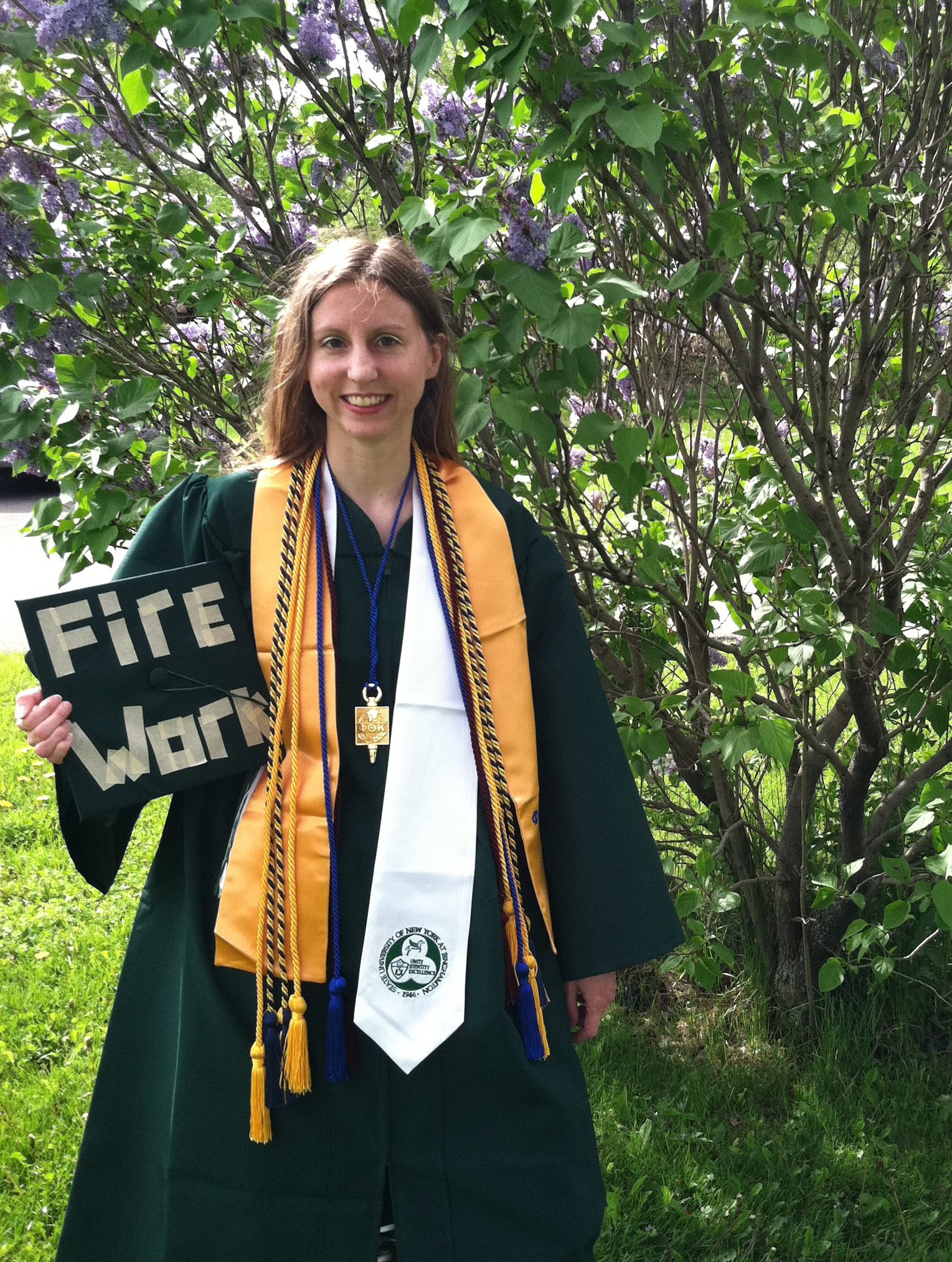
#TBT to my first degree when I was valedictorian but did not attend graduation. I have been in the top 10 for all of my degrees, but my attendance at graduations has been sporadic, contingent on many factors in my life at that time. This is the speech I had prepared to give well over a decade ago when I completed my first degree. For that degree, there actually was no ceremony, as I graduated in the “off” (fall) semester, so there was nothing to attend. Note that the above photo is from a degree that did have a graduation ceremony.
Speech
There are so many people to thank, that I could be here all day. There are so many inspirational people and speeches that I would love to emulate. Some of my favorite graduation moments, speeches, and phrases come from movies such as Reality Bites and Say Anything. I would love to say something epic that will inspire you to go out and do great things, challenge the status quo, and change the world.
But when it comes down to it, it really does not matter what I say as I stand here before you today. You will not remember any of it. Twenty years from now, you will not remember the speeches, you will not remember what you wore, nor will you remember the unease you now feel as your sock is slipping down into your shoe. What you will remember are the feelings and the people who are here with you today celebrating and sharing this most amazingly precious moment with you.
So, I will say this: people are what are most important in life. This is what we need to remember. Graduation is a great accomplishment. We have sacrificed ourselves, our time, and our future earnings in pursuit of education. Never forget the people who have supported you through this time and who are here with you today. It doesn’t matter how much money you earn, if you get that snazzy corner office, or if you end up waiting tables and riding a bicycle, what matters most are the people in your life. Your legacy will be the ways in which you are able to make life better, even if that person you better is simply yourself.
When you leave here today, be sure to hug your children, your spouse, your parents if they are still alive, and even your grandparents if they are around too. For while graduation is a huge accomplishment, it is only a flicker compared to the flame of love that is the people in your life.
We have all sacrificed something in order to achieve this accomplishment today. Remember to be thankful for every thing in life. We should not be thankful just on the day in November when the calendar tells us to be thankful. Be thankful every day. Congratulations on your achievement and go forth and spread love into the world.
End Speech
I am currently in the home stretch of my final degree with less than two weeks to go. While I oscillate between relief and excitement to anxiety and despair, there is a part of me that knows that these are the days I am going to miss. They say that college is the best four years of your life. It has been the best twenty years of mine. As I look to the future, I am scared. I have been in some sort of educational institution for over 30 years of my life. Some people have been institutionalized by the mental health system, some people have been institutionalized by the criminal justice system, and I have been institutionalized by the education system.
I am sure that at some point I will have panic over the fact that my academic career is over. What is perhaps most difficult is the fact that it is over whether I like it or not. Even if I do decide that I want to return to school in the future to complete a PhD, I am unable to do so because I have officially maxed my federal student loans. Unless some institution decides to give me a full academic scholarship, I am unable to continue with any more education. I am not sure what is scarier – the fact that I cannot receive any more education, or the fact that I have officially reached the ceiling for student loan debt.
I have been half joking and half serious lately that I do not want a graduation party. I want a retirement party. Twenty years in any field is a career. My career as a professional college student is ending. I am not simply graduating; I am retiring from being a professional college student. I will never stop learning, but I will now be learning by less formal means.
I am looking forward to retirement. I have employment I love, and the most amazing people in my life. I am looking forward to running more marathons, and surfing more waves. My library card will be getting a great workout. I think I may even be getting a fishing license for 2016. I will finally have time to devote to the people and things in my life that are as equally or more important than education, which have traditionally taken a back burner role to school.
A few months ago, when I posted about the penultimate paper (the last but one paper), I had foretold that this major life change would be a challenging time for me but that I hoped to be able to face it with grace. I’m not quite sure you would call this last month or so grace; it’s more like the break dance you inadvertently perform on a slick floor trying not to fall down. Whatever is happening, my life is about to change in major ways.
I’m looking forward to being able to Rewind Real Slow.
An update on my pulling the plug post, as one of the intentions of this blog is to hold myself accountable to my goals; I have not done well with pulling the plug on technology and making my interactions more meaningful. I was successful for awhile, but then discovered that I was not getting the type of engagement in real life that my brain required, and I tend to get more attention online than I do in real life.
The past two months have been a learning experience in how I interact with the world and have forced me to take a step back and evaluate my relationships more critically. The benefit to having an online presence is that it results in more interactions than in real life. By the same token, the detriment is that constantly being plugged in results in increased levels of anxiety and decreased ability to focus on the task at hand.
I took a digital sabbatical this weekend to unwind after a particularly challenging week of all things grad school on top of my normal day-to-day responsibilities. While my phone has been off and I have not been on social media, I have used an Ethernet cord to plug into the internet when I have needed to do something grad school related. Yes, I know the purpose was to unwind, but I am nearing the end here, and need to seriously get some work done.
What I have discovered these past few days is that the people who matter most in my life are already with me – my cats. Other than that, people so rarely contact me that I am sure no one is having meltdown over the fact that I have been unreachable the past few days.
I have discovered that I do, in fact, have a healthy relationship to the internet when I must access it old school via Ethernet cable. I only plugged in when I absolutely needed something this weekend, and not for more than 20-30 minutes per day. My downfall with internet and social media comes from my smart phone. That little square glowing diabolical hand held device that allows instant access to the internet at all times and from all locations.
With my phone off these past few days, I have gotten more accomplished on grad school, I have spent more quality time with my cats (those who are most important), and have even managed to read a novel for leisure that is completely unrelated to any of my degree programs.
I had a real-life in-person discussion a few weeks ago with someone whom I greatly admire about my desire to completely shut off my internet after grad school. That person persuaded me not to, arguing that internet is now a utility much like electricity or gas service, and that the internet provides me with a way to communicate. This is true. So while I will not be getting rid of internet service completely, my goal instead is to put better boundaries around its use.
Saved by the Ethernet cord is how I am going to accomplish this goal. Given that I do not have self-restraint with my so-called smart phone – once I am on the internet for one thing, I am looking at all the things – I will be turning my phone off more and plugging in my Ethernet instead.
I am quite sure that if it was not for the fact that I needed email for things grad school related that I probably would have only been online once in the past 4 days – and that would have been to double check the ingredients for a recipe about which I was doubtful.
I have not missed the status updates, the rants, the raves, or the photos. I more thoroughly enjoyed all my activities this weekend because I was fully present. I enjoyed the sunset. I enjoyed the beach. I enjoyed music. I have had the opportunity to plan my cross training schedule for when I am fully recovered from my running injury.
I am coming up on my last few weeks of grad school before my final defense. I may take a sabbatical every weekend I have off. Really, the only time I need my phone is if work needs to find me or I have to email for things grad school related. My stress levels have been a lot lower the past few days. I am looking forward to returning to work tomorrow energized and focused without the distraction of grad school panic and everything else that overwhelms when you are trying to finish a degree and do 10 million things.
Have you taken a digital sabbatical? Has it been relaxing for you? Have you noticed less anxiety when you turn the smart phone off?
If you are not on social media, how do you improve your in-person interactions? My problem is that I tend to get more interaction with people online than I do in real-life (even though the people I know online I also know in real life). With everyone so busy these days, how do you find or make time to spend with those important to you?
One of the great things about trying something new is the ability to experiment. Minimalism has been an experiment for me in being able to find balance in my life and focus more on experiences and people than on things. One of the more drastic ways in which I engage in this experiment is through travel.
The origin of the word vacation means to break away. Vacations are appealing because they are a respite from our everyday life. When we go on vacation, we have a break from our everyday responsibilities, which includes all our stuff. You only take what you need to survive and you leave all your other belongings at home without having to worry about cleaning or transporting them.
The past few times I have traveled, I have made a conscious effort to reduce the amount of luggage I take with me. To illustrate, perhaps the most extreme example of my tendency to over pack comes when I run a full marathon. I remember a race, maybe 5 or 6 years ago, to which I traveled and had 9 pieces of luggage.
Nine pieces of luggage.
My reasoning in this was: “26.2 miles – what could possibly go wrong?” I packed all the things. Every single bit of running gear I owned I took with me, because I was uncertain of the challenge I was facing and wanted to be prepared. It was like an episode of preppers for the insecure athlete.
I am happy to report that since that time of packing nine pieces of luggage for a full marathon, I have been able to pare down significantly. I flew to Chicago a few years ago for a 4-day trip and took only a backpack and my purse. I had no checked luggage. Given some of the transfers I had to make in certain airports, I was thanking my lucky stars I had no checked baggage to keep track of as well.
Not only did I take only one backpack, but also that bag had room to spare. I was able to take a few gifts for my hosts in that bag along with the essentials I needed for the trip. Before you gasp in shock and exclaim that this is an exercise in self-deprivation, it was nothing of the sort. I did not repeat a single outfit the whole 4 days I was there and even had an outfit for a more formal outing.
Back to running. Carrying nine pieces of luggage is challenging and problematic. It is even harder trying to deal with so much luggage when you have just ran 26.2 miles and your legs are oscillating between feelings of warm Jell-O and leaden concrete. Sometimes, your legs give out, other times they lock stubbornly, but either way, having to contend with nine pieces of luggage in this state is not happening.
I am happy to report that the last time I ran a half marathon; I was able to decrease my luggage count significantly. The last time I ran a half marathon, I had one backpack (the same one I had taken on the Chicago trip), and one cooler on wheels. I always have a cooler on wheels when running a race as I have multiple food allergies and it is helpful for me to have food and snacks on hand in case I have trouble finding food I can eat that won’t kill me right away.
The more challenging concern than packing for a half marathon was packing for a full marathon. The race I just completed I had two pieces of luggage plus the cooler on wheels. I had the same backpack, plus one additional small size boat and tote bag. I consider this to be a significant improvement from nine pieces of luggage. I was able to take everything from the car to the hotel in one trip and had fewer belongings to keep track of. How many times have you left something in a hotel room because you simply had too many things to remember to repack?
I am happy to report that with a backpack, boat & tote, plus the requisite cooler for food allergies, that I had everything I needed to not only be out of town for 3 days but also to run a full marathon. 26.2 miles what can possibly go wrong indeed? I learned that all I can do is prepare the best that I can. In 26.2 miles there are many things out of my control such as weather and course conditions. The only thing I can do is pack for what is reasonably expected and hope for the best.
In streamlining my packing, I have learned to be more mindful of what I am packing. Rolling clothes instead of folding them allows me to fit more. Rolling underclothes and putting them in large Ziploc bags keep them organized, easy to find, and dry. I say dry because I also used this packing method on my last two camping trips, and when you are camping in the middle of nowhere, dry underclothes are tops on the priority list.
I have learned to pack more tops than bottoms. The jeans I wear to travel someplace can be worn again on the trip back. If you do wear the same pair of pants two days in a row, no one is going to care. Even if I do spill something on myself, most places have laundry facilities onsite or nearby. Plus, there is always the old spot clean in the sink method.
When I would pack for a race with nine pieces of luggage, I learned that I was so focused on what could potentially go wrong and ensuring that I was prepared for every scenario that I failed to enjoy the actual experience I was there to have. The best memories are not often the ones where you arrive impeccably dressed and have a mediocre time. The best stories often come from the times when you were so connected with your experience you were having that it didn’t matter what you were wearing or those times when things went so wrong that it was hilarious.
I consider my new methodology of packing to be trial runs for my ultimate dream of being able to backpack through Europe. I have a passport that has never been stamped, and if I ever get the opportunity (read: have the funds) to cross the Atlantic, I want to be sure that I am fully engaged in the experience and not worrying about the luggage I am dragging with me across a continent.
My new method of traveling with simply a backpack (and sometimes the food allergy cooler depending on the scenario) has given me more freedom to be more present in my experiences, more freedom to actually explore new locations, and has gotten me asking harder questions about the state of belongings in my home.
If I can survive for 3 or 4 days with only a backpack, what items in my home are really necessary? What could I get rid of or live without if that magical moment ever came where I had the opportunity to do a large inter-state or cross country move?
Traveling with less is a safe way in which to experiment with living with less in general but also with having a smaller wardrobe specifically. Having a smaller wardrobe means less laundry, less decision fatigue, and less stress in the mornings as I no longer stand in front of a closet with “nothing to wear.”
If you are looking for ways to experiment with simplicity in your life without making a full commitment, then travel may be the option. Think about how much luggage you typically have on a trip and think of ways in which you can cut it down.
I did not go from nine piece of luggage to one backpack overnight. It was a gradual process over the past few years (and marathons) that I worked to cut it down. I went from nine piece of luggage to seven, to five, and on down. At one point, I fit everything into a medium size duffel as my one piece of luggage. Then, I reduced the medium size duffel to a small size duffel, and finally a backpack.
How much freedom would you have while traveling if you could transfer planes or simply come off the plane without having to wait for baggage claim? You just grab your bag and explore the new place where you have landed. There is a lot of freedom in that. You can explore your surroundings immediately without having to check in to a hotel right away or trying to find someplace to store your luggage while you wait for it to be check in time at the hotel.
Let your next trip be an experiment in living with less. This is not about self-deprivation. This is about freedom. What do you really need to survive?
I’m working on writing my now second masters thesis, and I can tell you that in this process and many others, lots of things go out the window. The first is my APA (American Psychological Association) publication manual. Literally. Anyone who has written a document of any length can attest to the frustration, tears, and sometimes screams that accompany the creative process. Sometimes, in frustration, I throw my publication manual.
If it happens to be a nice day, and the windows are open, it flies out the window.
What is not okay to throw out the window are our positive coping skills and ways in which we engage in self-care. Yet of course, those are always the first things to go when things get busy. Schedules change from summer to fall and all of a sudden after work; we are rushing to this club or that game or some event. We no longer have time to engage in the yoga, reading, whatever it is that we do to replenish and rejuvenate our soul.
It’s very easy to do when things are rough financially as well. You are so worried about paying the light bill, the rent, and all the other necessities that there is no money left over to do anything fun. That may be true; it is reality for a lot of people. Yet, when we are at our most busy and overwhelmed times are when we need self-care and fun things the most.
You cannot keep pouring juice out of an empty pitcher. Unless you are a magician of some sort, once it’s gone, it’s gone. Yet repeatedly we overextend ourselves and run on empty.
How is that going for you?
It’s time to stop. The time you are most busy is the worst time to throw self-care out the window. If you have been going at a pace that makes a marathon look like a sprint, then it is time to slow down and embrace those things that nourish your psyche.
Sometimes we are forced to slow down. Major life events, usually an emergency, illness, or injury can force us to slow down whether we like it or not. It is usually karma’s way of saying, “hello, don’t throw self-care out the window.”
What have you done to be kind to yourself today?
Can you take even 5 minutes to turn off the phone and electronic gadgets, shut the door, and just close your eyes? Can you escape the whirlwind that is your racing mind?
I have been receiving massage to help the healing of the hip muscle I tore in my most recent marathon. I have not received massage in quite a while – not since I had employment at which I was making double what I make now. I am not sure if it is busyness or just thinking that massage is a luxury I cannot afford, but the thought to schedule a massage has not crossed my mind.
While massage is indeed helpful with my hip injury, it is perhaps even more helpful for my mind and stress levels. As I was lying there allowing someone to work on my injured hip, I remembered how important it is to take care of oneself. Massage is a luxury that I cannot afford, and probably would not be getting if not for my injury. Yet, it reminds me that every once in awhile we need to do something beneficial for ourselves even if it seems to be a little extravagant. Those are the types of things that keep your pitcher full. Those moments when you take time out to replenish yourself so that you can continue to give to others are just as important as what you do for others.
What goes out the window when you are really busy? Can you identify one activity or thing that you can do to replenish yourself at times when you need it the most?





 rewindliveslow