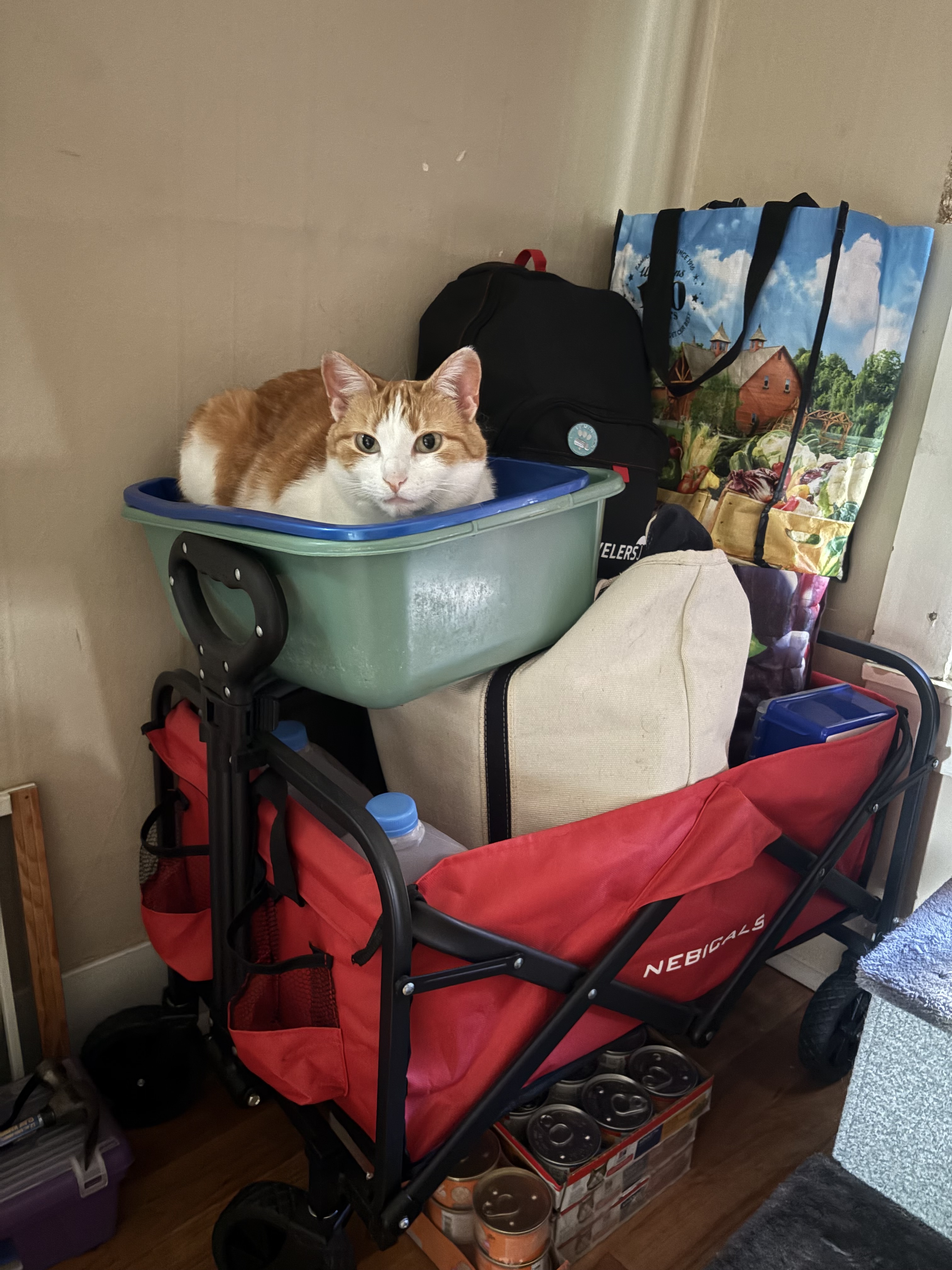
June is Pet Emergency Preparedness Month. If you have pets, you need to be sure that they are included in your emergency plan. Do not leave them behind. Be sure you have supplies for your pets for an emergency. Everyone should be carrier trained.
As you may know if you follow my cats on social media, Simon was the most difficult to carrier train. When we were at the old house and a tornado stopped a mile and a half from the house, he was the only cat I could not get to the basement in time. He hid in the cupboard under the kitchen sink. He was right above the basement, but I was very worried.
Since that tornado, I focused specifically on carrier training Simon.
When Jude was alive, he was carrier trained. He was the first one to be carrier trained. With Jude, it was easy. He was very food motivated. I started carrier training Jude when Kitty was alive. Kitty was a senior (he passed from cancer at age 19) and ate slowly. Jude would try to steal Kitty’s food. So, I started putting Jude’s food dish in his carrier at mealtimes. He went right inside. I closed the door. I let him out once Kitty was done eating so he could not steal Kitty’s food. When Jude, wanted food, he went in his carrier.
Jude also enjoyed touring the basement at the old house. If I opened the basement door, he would go down with me. So it was easy to get Jude in the basement for a tornado. It was easy to get Jude in a carrier if we needed to leave the house.
Jolene was also easy. Jolene is glued to me. She follows me everywhere. She has separation anxiety when I am out of the house. That’s a story for another day. But Jolene would follow me to the basement. If I walk to her carrier, she follows me. I just pick her up and put her right in.
Simon was the most difficult to train. When I trapped Flower, I made sure that I carrier trained her also. Flower was trained in a different way than Simon. Flower was easier to train.
Many people have asked me how I managed to train Simon and Flower, so I will share that here. Keep in mind, that while this worked for Simon and Flower, it may not work with your cat. This is just my experience.
Starting with Simon, let me first say that consistency is key. You literally need to practice every single day. It can take months. Since we have been in the new house, I have not been practicing with Simon, and you can tell. I have not been practicing with them because I have been trying to give them all time to decompress from the trauma we experienced with the repeated neighbor attacks and physical injuries. We lived the emergency. Now we are trying to recover from it.
The one thing I do with all my cats is that I leave all the carriers out all of the time. This way the carriers are familiar objects in their environment. They are not scary. They do not associate them solely with vet visits. There is a comfortable blanket inside the carrier and one on top. They can go in and out of them at will. They can sit on top. They think of the carriers as part of their play space.
If you have multiple cats, you may not have space to leave all the carriers out all the time especially if you have children and a family. In this case, leave out just one. We are fortunate that we have the space, so each cat’s carrier is out all the time.
The cat carriers are always in the same space. They are in their feeding area. They eat in front of their carrier. This helps them become familiar with the carrier and associate it with something positive (food).
Simon is timid and shy. For him, the carrier is a scary place, even if it is a permanent fixture in his environment. For Simon, I started with the lid and door off the carrier. The only part of his carrier that was out was the bottom part.
For a few weeks, Simon would eat his food in front of the carrier with the lid off. He was comfortable. I gradually started putting the dish closer to the carrier. Eventually, I put his food dish inside the carrier (all of this is with lid off). I went at Simon’s pace. Sometimes it was one step forward and two steps back. If I put the food dish inside the carrier and he acted scared, would not approach his food dish or enter the carrier bottom, then I took the food dish back out and put it just outside the carrier again.
This was all at Simon’s pace. Of course, it took weeks and months. You need to be consistent. It takes a lot of patience.
Going at Simon’s pace, he finally got to the point where he was comfortable with having at least half of his body inside the bottom part of the cat carrier eating his food. I just kept putting the dish a little closer to the back part to get him to go inside. Again, this is all with the lid off.
When he finally got to the point where eating inside the bottom part of the carrier with the lid off was routine, I put the lid back on. I left the door off. Lid on, door off. This was again one step forward, two steps back.
With the lid on and the door off, I started at the beginning. I had to. Putting the lid on was scary for him. We started with eating right in front of the carrier. Slowly putting the dish closer to the carrier. Putting the dish just inside the carrier. Exact same process until he finally got to the point where his body was at least halfway in the carrier to eat.
Once he was comfortable eating in the carrier with the lid on, I put the door back on. Repeat process. Putting the door back on was the most challenging part, but we got there.
Once he became comfortable eating inside the carrier fully assembled, then I started closing the door behind him. Just for a little bit. Then opened to let him out. It was only for very small periods of time so he did not get stressed.
You gradually increase the time until you get to a point where he is comfortable enough in there that you can pick up the carrier with him inside and set it back down a few feet away. Let him out of the carrier. This helps him to learn that it is ok to be inside with the door closed, it is ok for someone to pick it up and move you. The door will open again, and he came right back out. We went on small “trips” from one end of the room to the other.
Months of training paid off. The last tornado warning we had at the old house, I was able to get Simon into his carrier and take him to the basement.
I went to the food cupboard for treats. Put the treats inside the carrier. He went inside for the treats. I shut the door and carried him to the basement. It worked.
In the new house, we have not been practicing since we are all decompressing from the abusive neighbors at the old house. However, he does still eat every meal in front of his carrier, so it is not a scary place. Sometimes he does go in there voluntarily and lays down and takes a nap.
Carrier training them was very helpful when we had to leave the old house for the Drive to Freedom and then spent several weeks in temporary safe housing. Simon knew that his carrier was an ok place. He was not scared.
Training Flower was different than training Simon. With Flower, I had been using treats as rewards for socialization. I would make a trail of treats to try to get her out of her safe area to come to me to interact. If she appeared for pets, she got treats. I also started using the treats to train Flower in baby sign language to give her something to do to stimulate her brain. Flower has physical disabilities so she cannot play a lot. She needed something to keep her active and interested.
Using baby sign language and treats, Flower learned the sign for in. She learned if she went inside the carrier when I made the sign, she got treats.
As Flower progressed in her socialization and comfort level in her home, I was trying to get her to go downstairs to be with the rest of the family in our living space instead of being by herself upstairs.
In the mornings, I would sign in for Flower to go in her carrier. I carried her in her carrier downstairs, and she had breakfast inside her carrier with the rest of the family. Then I took her back upstairs to her safe place. Flower eventually learned that if she went into her carrier, the “magic box” would take her downstairs (or upstairs if she was already down). She learned if she went inside, she would get food.
Flower learned to associate the carrier with positive things. As Flower has progressed with handling, I can now just pick her up and put her right in the carrier. She does not struggle or protest. It’s honestly easier to just pick her up and put her in there in the new house. She is now fine with all handling.
Even though she is carrier trained, Flower no longer goes near her carrier in the new house. In the new house, the entire first floor of this house is her territory. Her world is a lot bigger here than it was in the old house when she pretty much did a little loop between her cat bed, carrier and cat pan.
A few times when Flower is out and about and near her carrier, I have done the sign for in. Flower sees the sign, has gone in the carrier, and get treats for remembering what to do.
However you do it, carrier training your pets is important in case there is an emergency. Include your pets in your emergency plans. Do not leave them behind. They will not survive without you. They rely on you for so much.

