Seattle #TBT

IMG_9466

Monthly #TBT from when I returned to the east coast from the west, and all the thoughts and feelings a decade brings.

When I think about leaving the west coast and returning east in 2005, I think about freedom. Everything we owned fit right into the back of a pickup truck. I took one backpack with me on the plane from Sea-Tac to Upstate New York. I was perfectly content with being able to wait a week with the contents of that pack while the rest of my belongings arrived. While books, CDs, and other household items make one feel comfortable and help to fill the time, they are not necessary to survival.

Fully embracing your local community and taking advantage of what is readily available is key. Using farmers markets and shopping locally not only helps your neighbors financially, but helps you to make friends as well. When we were in Seattle, we were constantly going to this show and that show, and having the best time with people – all by word of mouth without things such as Internet and social networking.

While it took time to build this same foundation and network on the east coast, we did build. It started with a poster. Go to a show. Talk to like-minded people who hang out in the same places as you, and suddenly you have a group of friends with common interests.

What I miss the most about the west coast is that it was affordable to live right in downtown Seattle and be within walking distance to practically everywhere. While we did have a truck, it often set idle in the driveway. Many times, we could bike or walk any place we needed to go.

On the east coast, housing is too expensive to live in a city or town to be able to walk or bike anywhere. On the east coast, vehicles are a necessary evil, as housing prices are more affordable in the suburbs, and things that you need like grocery stores and medical care are too sparse and spread out to be able to rely on public transportation. Not to mention, public transportation on the east coast often runs infrequently with limited routes.

Seattle reminds me of being able to throw the surfboard in the back of the truck and spending a day at the beach. Literally everything you needed was readily available. There was no need to have a vehicle on a daily basis unless you wanted a beach excursion or other type of road trip.

I’m sure that things have changed since I left the west coast- housing prices and availability for one. There is something to be said about being able to pack up all your belongings in two or three storage totes and pick yourself up for a cross-country relocation. There is freedom in not having to spread yourself thin trying to get to work, obtain groceries, or run other errands. On the east coast, the geographic challenges tend to contribute to more social isolation, and thus I feel it necessary to have more entertainment and distraction options in my home – movies and books for when the snow flies, and everything shuts down for a day, buried under feet of white stuff.

While hindsight is 20/20 and often viewed through rose-colored lenses, the aspects of coming back east that stick with me the most is how much I experienced on the west coast with so little belongings. When you settle in one place for an extended period of time, as I have been on the east coast, you accumulate stuff. Life was so much simpler without all the things.

It is thoughts such as these that contribute to my wanting to rewind real slow. That yearning for the wanderlust of youth when you had exactly what you needed, and nothing more, and if someone said, “let’s do this,” you enthusiastically replied “okay.” Seattle also taught me that I was put on this planet to live. Living is not simply working and paying bills. I deserve to have experiences in my very short time I have to be on this planet. That is a lesson I often forget in the nose-to-the-grindstone mentality of east coast workaholics.

Seattle is also special because it is the last large expanse of time in which I remember being present. Before the widespread use of smart phones, constant pings and notifications, social media, etc, we lived every day in the moment. Life really was much simpler when if you wanted to see or talk to someone, you had to find them, and if you could not get there due to distance, you wrote them a letter. The mail takes 3 days.

Ten years of living the grind on the east coast has definitely taken it’s toll. In my efforts to rewind real slow, I am hoping to return to some of the ease I felt on the west coast. Not only the relaxed pace, but the ability to live in the moment without fear of the future. The desire to recreate that feeling anywhere without being geographically bound to a particular location is what I am hoping to achieve. They say home is a place you carry with you. I am trying to build that feeling for myself where I presently am.

Is there a certain place in your life that elicits certain feelings? How can you recreate those feelings in your current location? Whether nostalgia or rose-colored glasses, how can you work to create experiences you envision?

Beauty in the Breakdown

14

In 14 races, I ran my worst marathon this past week. It was wicked hard, but it was also an amazing learning experience. They say you can’t enjoy the good runs unless you know what it is like to have a bad run. Well, now I can appreciate the good runs more.

In this race, I learned what I like and don’t like in a race. I learned how to push myself way beyond my comfort zone. I learned to rely on my training. If I had not been adequately trained and prepared for the challenges I faced, then the outcome would have been a lot worse that what occurred.

As far as the race itself, this is what it taught me: I do not like small races. With only 3,000 runners, this was my smallest marathon ever. I usually do the large city races with 30,000-40,000 runners. In such a small race as the one I just did, there is not a lot of crowd support, and medical care is so stretched out that it’s scary. I am used to the big cities where thousands of people line the streets screaming each and every mile unless I’m running on a bridge. I am used to having a medical professional within eyesight for the entire 26.2 miles. The positives in running a small race and learning this, is that I was able to prove to myself that I can make it without those amenities. I was able to push through and finish the race without an iPod, without cheering crowds lining the streets, and without the constant presence of medical support. I can run a marathon without those amenities. Do I want to run a marathon without those amenities? No, I don’t.

I sustained an injury to the TFL (tensor fasciae latae) muscle in my hip somewhere between miles 18-22. If I had been on a course in a much larger city, medical professionals would have noticed the injury sooner and pulled me off the course. I would have been a DNF (did not finish). Instead, I pushed on to make the finish line. First, I did not understand exactly what was wrong or was happening, and second, I am one of those stubborn runners who push on just to get the medal.

I am fortunate in that I was adequately trained to be able to handle this injury in such a way that it will eventually heal and I am expected to make a full recovery. However, sustaining the injury has led me to a second reason why this was my worst race ever.

The course description was not accurate. Most course descriptions are not accurate. I have run marathons described as flat that were in fact gently rolling hills. I have run marathons described as gently rolling hills that were in fact downhill. While most race descriptions are not entirely accurate, they are usually pretty close to truth. This particular course was described as downhill, so I trained for a downhill race. What it was, in fact, was a hilly race. They were not gently rolling hills. They were not rolling hills. These were hills. There was a huge discrepancy in the description and elevation maps compared to reality. Sure, there were many course changes prior to the event, that required re-certification and new measurement, but there was a gross discrepancy in what was described and how I spent 5 months training.

After my injury, the medical personnel confirmed that the injury would have been much worse if I did not have the muscle tone that I have. I trained for a downhill course, and that was what I was prepared to run. A course that was extremely hilly put more pressure on my body that it could handle; I was not prepared for hills. HILLS. They were not rolling, nor were they gentle. I have run hill races before. I have done fine on hills courses, when that is what I have trained to run.

This race also taught me that the 2015 training season was my best training season ever. I was very well prepared to run a marathon. At my 18 mile split, prior to injury, I was on track to set a PR and within minutes of a potential BQ. At the end, it all fell apart due to injury and ended up being my slowest marathon time by over an hour. The important part was that I was able to finish and was not a DNF.

I have learned to do better research when looking into races to run. I usually try to choose established races so that kinks like this have already been worked out. This marathon was the 20th anniversary – I figure 5+ years to be my barometer for “established.” However, due to the drastic course changes that occurred in the weeks right before the race, the course I experienced was way different than the one for which I trained.

I will definitely be making changes and improvements to my training for 2016 to be able to strengthen the muscle currently injured. Right now, I am thankful that the surrounding muscles are strong enough to be able to support the one that literally took one for the team.

I am so thankful for every single day that I get to run. I can’t wait to heal and to come off the injury list to be able to run again. This race and this injury have taught me that I am so blessed to have been able to participate in 14 races so far. While I am looking forward to many more, I need to be able to continue to run smart.

I can’t believe that it took me 14 races to learn that I do not like small town venues. You grow through pain. You also learn so much about yourself once you go beyond your comfort zone. While this was my most challenging race in 14, I feel like I have learned so much about myself that is only going to improve my race decisions, training, and preparation for the future.

There is beauty in the breakdown. Without this experience, I would not have learned what I was capable of doing, or how adequate my training is, or what I don’t like. Sometimes knowing what you don’t like in life is as valuable as knowing what you do like.

I have been very fortunate in my running career thus far in that my good runs and races have way outnumbered my bad runs and races. This is pretty much only the second time in 14 races that I am saying, “I will never run that one again.” For the record, the other race I have said that about is due to logistics of the host city surrounding the race, not the course or race itself. This is the first time in which I loved the host city, but loathe the race.

I have learned so much through this negative experience than I have through my positive ones. The beauty in the breakdown is being able to take this knowledge to ensure that my race schedule for 2016 is amazing.

I’ll be on the injury list for the rest of the 2015 season, but I’m looking forward to the 2016 running season as being stronger, faster, and better. That’s the beauty of the breakdown.

Running Down A Dream

DSCN1670

Boston. It’s the Holy Grail of running. Every runner strives to earn a Boston Athletic Association medal. We throw around acronyms like BQ, PR, maxO2, and Gu. Ok, so Gu is a food group, but you know what I mean. Most likely when you meet a non-runner who finds out you run marathons, one of the first questions they ask is, “have you done Boston?” If you are in the Midwest, they probably ask, “how many Grandmas have you done?” referring to Grandmas Marathon, not your beloved senior citizen relative.

Everyone knows about Boston. Boston is the oldest, most prestigious, and has the strictest qualifying guidelines of any race outside of the Olympics. Qualifying standards for Boston are like Victorian chastity belts with a lock and key. Each year we look to see if the standards have changed, and pray for more birthdays so that we can change age groups to perhaps a less competitive one, or simply to get that extra 5 minutes to qualify. Many non-runners do not even know or understand that you have to qualify for Boston. You have to be invited. It’s like waiting for the fancy invite in gold calligraphy to be delivered to you by a guy in tuxedo tails wearing white gloves on a red carpet. You do not just “sign up for Boston.” It’s an elite club that not everyone can join. It’s kind of like a country club, except this one has lots of sweat and trail mix involved.

It is every runner’s dream to cross the finish line in Boston. It is truly the people’s Olympics. The finish line in Boston is the physical manifestation of everyone’s hopes and dreams as they sweat, train and run to achieve what less than 1% of the world population does – run a marathon. The magic of Boston is that in addition to all the professional runners who have 7 hours a day to train with professional trainers and chefs, it is also the housewife who rolls out of bed at 4am to get 15 miles in before the kids are awake and works in a supermarket that can qualify for Boston. You rip a training plan out of a magazine, and say, “I’m going to run a marathon.” Maybe your sister just got a cancer diagnosis, and you’re going to raise money and work with Team in Training (lymphoma and leukemia research). Maybe your mom just passed away from breast cancer, and you are going to run 26.2 with Donna (the marathon in Florida where all the proceeds go to breast cancer research). Maybe you ran a 5k with your kid and remembered how fun and free it feels to run and just “caught the bug” to run a marathon. Maybe you want to lose 40 or 60 or even 100 pounds, and start out just by walking around the block.

Whatever your story, wherever we come from, we are runners. We all have the same dream. The beauty of Boston is that the dream is attainable by any of us. Boston is not just for the people who have the privilege of making Olympic Dream Teams. Boston is the dream that many of us everyday people who have mortgages and kids and work 40 or more hours a week can make true.

Personally, I do not run fast enough to qualify for Boston. Maybe in a few years, once I reach the Masters category, and some minutes are tacked on to my qualifying standard, I will, but I’m not going to hold my breath. I would have to shave at least 40 seconds off of each and every mile to qualify for Boston. The full marathon is not my fastest distance. It is my most favorite distance, but it is not my fastest. Something happens between miles 22 and 26 where, even if I have been on track to earn my BQ, I completely lose my mind and blow it.

My best distance is the half marathon. I have qualified for and ran the Boston Half Marathon, which is how I earned my Boston Athletic Association medal. I don’t mind running half marathons. I do like to change up my race distances every now and again. The half marathon is not my favorite distance. The full marathon may be my most challenging, but is also my favorite.

As I have gotten older, and am approaching the Masters category in a few years, I still have a dream of Boston and getting my BQ. I am not going to kill myself for it. Yes, I can sit there and crunch the numbers and amp up my training, but what is more important to me at this point in my life than achieving my BQ is ensuring my health and safety to be able to run as long as possible throughout my life. Getting a BQ is not going to mean anything if I push it so hard that I sustain an injury that ends my running career. I have already overcome so much to be able to run marathons: a total of 10 broken bones, which includes breaking my spine in three places and spending time in a wheelchair, to 5 concussions, to a patella tear that almost did end my running career.

I am part of this magical community called runners in which we wave at each other as we pass on the trail, we help each other when we are struggling, and we line the streets to cheer for random strangers as they participate in their distance event and run pass. Yes, I am screaming for you, Random Citizen! You are not almost there, but you do look amazing, even if you are grimacing like a monkey humping a football because you are living your dream of running a marathon! That makes you look beautiful.

It doesn’t matter if you get a BQ or not. It does not matter if you come in first, middle or last. It doesn’t matter how many people have crossed that finish line before you, as long as you cross it. Many of us will never get our “15 minutes of fame.” But, you will get 1 second. That one second that your foot hits that finish line and clocks your time for completion, that one moment that you finish your marathon, whether it is your 1st, your 15th, or your 20th, that one moment YOU are the greatest athlete on the planet. That one-second is yours to own. You can say, “I did this.” “I ran a marathon.” Less than 1% of the world’s population can say that, folks.

Boston is every runner’s dream and it is always out there. For me, what is most important is not that I cross the finish line in Boston, but that I continue to keep crossing finish lines anywhere. We are all part of the same community. Boston is the oldest, most prestigious, and most beloved race. Even if you never achieve your BQ, that finish line belongs to all of us. It is the embodiment of all our hopes and dreams. If you never qualify for the bib, you can go spectate. You can still be part of the dream. Whether you are on the race course or part of the crowd, the magic that is Boston will course through your veins. A popular saying has been attributed to many, so it’s origin is uncertain states: “If you ever lose faith in humanity, go watch a marathon.” It’s true. Even if you never get your BQ, the magic of Boston can be experienced just by being there. Boston is every man’s dream.

As I approach medal # 14 this weekend, Boston is still my dream. Always was, always has been, and always will be. I chose one of the top ten fastest race courses in the country with a net elevation drop of 800 feet for my 14th race in an effort to qualify. Will I get my BQ? Probably not. But I will cross the finish line, and I will be able to train next year to cross a finish line somewhere else again. I will cross the start line. I will cross the finish line. I will run a good race.

Every April, whether we have achieved a BQ or not, the world watches with love and hope as people run the Boston Marathon. We are all running down a dream.

Portage

IMG_0534

They say portage comes from the Native American practice of carrying a canoe and all of your belongings over a body of water. Everything that you own travels from one side of the river to the other. While the most freeing moments in life have been those that I was able to carry everything I owned in a backpack or duffle bag, they were also the most challenging. There is something comforting and stable about the notion of home.

In the same manner, turtles carry their home on their backs. With the contraction of some muscles, they can put all their extremities inside their shell. If a turtle looses his shell is he naked or homeless? Turtles have freedom to go where they please, and home is always with them.

When I attempted to move back to Boston a few years ago, I started by taking everything out of my storage unit and putting it into my house. If I was going to complete an interstate move, then I needed to pack everything up and take it with me. In retrospect, I am glad that my plans fell through. Downsizing and minimizing has shown me that I would have been lugging a whole bunch of unnecessary items across state lines. This is a hardship that I do not need to endure. As I have gone through my belongings, I have not only learned what is important, but have come to realize that the timing of that “move” was completely wrong. I was not ready in any sense of the word. Sometimes, answers come in the form of not getting what you want.

In the past three years since my move fell through, I have taken the opportunity to pare down. I opened every box that was in storage. If you have things in storage that you are not using every day, do you really need them? Are you keeping things “just in case?” Has that “just in case” event happened in the last 3, 5, 10 years that you have paid to have that item in storage? As I went through everything I had in storage, I did pull out a few items that are now in use. Those items are the exception. I saw that many of the items in storage were unneeded or redundant. I am glad I have had this time to shed those items and did not lug them through a few states. Moving is expensive enough without hauling things you don’t need.

Going through the process of downsizing and minimizing has been very freeing these past few years. It has helped me to realize what is important and what is not. I have realized that the accumulation of stuff is sometimes a defense mechanism – a sense of false security – after having nothing for so long – to accumulate items in an effort to feel accomplished. These items are not comforting at all. I have been weighed down by baggage both physically and metaphorically.

While I doubt that I will ever return to the days of having everything I own fit into one backpack, it is freeing to have less. I am not one of those minimalists who count my belongings and strive for a certain number. Rather, my goal is to have enough; enough to be able to experience my life in a way that brings me joy and no more.

As I pare down my house, I try to keep in mind that the next time I plan an interstate move, I want it to actually happen, not fall through. I am trying to prepare myself to be able to pick up and go if the chance arises. If that opportunity never knocks, then I want to be able to enjoy my life where I am while living lightly.

Going through and getting rid of the items in storage was relatively easy. Now everything I own in this world is inside of my house. I am free of the monthly payment to store stuff I did not need – the ultimate definition of pissing your money away.

The hard part now comes of being able to establish the limit of what constitutes enough. The hard questions now need to be asked: Is this item useful? Does it bring joy to my life? How do you know how much you need?

I have tried to set limits on certain items to ensure that I am only surrounded by that which I love and get rid of the excess. All books must fit on the shelf. If I want to keep a novel, and the shelf is full, then one book must go to make room for the one I want to keep. I have been trying to engage in the practice of joy without ownership. My library card has been getting quite the workout, as I check out books, DVDs, and even CDs to enjoy media without the responsibility of possession or ownership of the item. My barometer has been if I check an item out of the library two or three times, then that is an item I probably need to look at owning. If I only check it out once and then forget about it after, it was an item that I did not need to have in my house long-term, and I was better off borrowing than owning.

It is a delicate balancing act trying to figure out one’s comfort zone. I still look around and think that I have too much stuff, especially when contemplating a(n imaginary) move. Yet now it is more challenging to be able to figure out what is necessary and what is not.

Some of it is fear. Where I am now is the longest I have lived in one place in my life. I feel stifled by complacency. There is the fear that how I am living now is too good to be true and that it will all fall apart someone how. There is the fear of returning to the world of my 20s in which my living situation was precarious, and a car is simply a house on 4 wheels.

Yet overriding the fear is hope. There is hope that I am not done yet in this journey called life. There is hope that the best is yet to come, and that I must be prepared to answer its calling. If I am asked to cross the torrents of the river, then I am readying my canoe to be portaged across that river. While most of my life has been a struggle to survive, I am now at a point where I am ready to live. I do not want to be weighed down by stuff that may stifle opportunity to experience some of the best moments of my life.

Like the turtle, I have finally come to realize that the notion of home is something that you always carry with you. It is in the journey, not the destination that life’s greatest moments occur.

Are you ready for portage? If someone offered you your dream job tomorrow in a city that was 5 states away, would you be able to pick up and go? Are you tied down by your stuff? Would you run around frantic trying to figure out how to pack and move the house? Many times, opportunity only knocks once. Letting go of what holds you down will enable you to live the life of your dreams. You do not need to have a certain number of possessions. What you need to have is enough to make you happy, without having too much that tips the canoe.

Playing Dress Up

IMG_1066

Children love to play dress up. Many times you will find kids clomping around the house in your shoes, trying to wear your shirts or hat. They love to pretend to be different things. Adults like to play too. Look at Halloween coming up later this month. Children and adults alike seem to enjoy the fantasy that goes into pretending to be something you are not at Halloween. This is your chance to be an astronaut, a ballerina, a superhero, anything you want to be. It’s fun.

We do the same thing in our everyday lives not only with our clothing but also with our possessions. Look around. Do you have a family of 4, but place settings for 12 because you have always dreamed of being the one to host the big family holidays, with a house full of loved ones? If you do, and you actually are able to use those 12 place settings to achieve that family gathering, then that is great. You are living the dream. Do you have 12 places settings with a family of 4 and never use the 12 for the large gathering, but simply only 4 or perhaps 6? Now we are getting somewhere.

If they are not in use, you are probably keeping them just in case. Those place settings are representative of your fantasy self. You may not be play dress up pre se, but you are imagining a life of hosting gatherings that you are not actually living. How do those extra, unused place settings make you feel? Sad? Overwhelmed that they are taking up space in your cupboards and you have to move a stack of plates to get to your favorite mixing bowl?

Get rid of them.

That’s right. Get rid of them.

Whether it is extra plates, those 4-inch heels you bought to go with the power suit you never wear, or the sports equipment for an activity in which you never engage, get rid of it.

It’s hard. Often, we buy things for the way we want to see ourselves and not for the way we actually are. We buy that shirt because we think wearing it will make us look just as glamorous and appealing as the model in the magazine. We buy that piece of outdoor equipment because we think it will make us look sporty, just like the commercial. Are you living a life of a TV commercial? Or are these items just reminders of things you want to do but do not have time to do?

In an effort to minimize, or rewind, we need to let go of false selves. Get rid of the baggage. Yes, you may have dreams of hosting house parties every weekend, but is that actually happening? If you want to host parties, host them. If it is not a reality, then get rid of the baggage that is weighing you down.

It is much easier to live with the things that are useful and enhance our everyday existence. Why hold onto ice skates if they only remind you of the one time you used them and have never been on the ice again?

Simplifying items associated with fantasy selves is one manner in which we can simply our houses so that they contain what is useful, what is beautiful, and what is loved. A house containing only these items is easier to clean, holds more positive energy, and allows more opportunity to engage in the experiences and activities you truly enjoy.

For me, I am currently looking at my spare bedroom. I have a genuine guest room that is set up to host company for a weekend or a few days quite comfortably. I have always wanted to be one of those people that are able to have people over to visit – family and friends from out of town have a place to stay if they decide to visit the area. Do I ever host company in the way I envision? No. I live in an area mostly surrounded by cornfields and cows. You can see those pretty much anywhere outside of a city limits. No one visits me here. My spare bedroom is a form of my fantasy self that wants to be a hostess for out of town guests. Would that room be more useful for some other purpose? Could I give the bed and the other accompaniments to someone who is more in need of them? Could I empty that room entirely and save money by moving into a smaller living space?

We all love to play dress up. If you’re dressing up for Halloween, that’s fun. What ways in your everyday life are you pretending to live a fantasy life? Is this an area of your life you can simplify? Remember that we cannot take it with us when we go. When your relatives are going through your belongings after you pass, are they going to find a pair of skis and wonder, “I never knew (s) he skied?” Only keep things in your life that are useful, beautiful, or enhance your experience on the planet.

What fantasy self do you need to say adios to today?

Dirty Laundry

IMG_9664

I have always worked Saturdays. Always. I have been in the workforce over 20 years & even when I was a social worker with a traditional day job, I was still required to be on call on weekends. I do not mind working Saturdays. I would rather have a weekday off to do things when places are less likely to be crowded.

A few weeks ago, I realized just how stressful Saturdays have been. Especially, when I was working 60+ hour weeks, everything was crammed into Saturday night because that was my only night home. In my efforts to rewind real slow, I had not yet made adjustments to that routine. Until now.

Up until a few weeks ago, Saturdays went pretty much like this: come home from work and immediately start the laundry, as I typically have two loads per week. Then, I had to start preparing a week’s worth of food because when you have multiple food allergies, you can rarely do food on the fly. Then, I would have to sit down and write some paper for school, which in my educational programs have typically been 20 pagers. In fact, I have it down to a science. Once all my background prep work is done and I am ready to start actively writing, I can typically crank out 20 pages in 24 hours. To put the pressure on even more, I was also trying to get to bed at a reasonable hour, due to my Sunday morning long run. Whew. It makes me tired just writing about how it used to be, but is no longer.

Once I identified that this routine was the cause of so much stress, I was not only able to realize that I needed to make a change, but that the stress all started with dirty laundry, literally and figuratively.

While cramming all that stuff into Saturday afternoon was once a necessity due to an over packed schedule, I now have more free time and control over that time.

I no longer do laundry on Saturday. I do it during the week, often one load at a time. Since I am home more, I have the luxury of doing laundry whenever and not trying to cram it into a schedule.

I also no longer need to have monster paper writing sessions in which I am cranking out 20 pages in 24 hours. Unless I have procrastinated ridiculously with my time, I now have several days during the week to work on school.

Making these minor adjustments to my schedule have been hugely significant in lowering my stress levels and increasing my happiness. Dirty laundry is just another reminder that although we may spend 40 hours a week working, what we do with the rest of the time we have is purely our choice.

What areas of your life are you able to identify as creating stress? What routines can you alter or change in order to decrease your stress and save some time?

I have noticed that now when I come home on Saturday and no longer face piles of dirty laundry, both literally and figuratively that my weekend goes much more smoothly.

I still have not yet found the cure for procrastination when it comes to thesis writing, so if you figure that one out, let me know.

What dirty laundry can you change today?

Ottawa 2008 – #TBT to medal # 2

IMG_6745 IMG_6746

In early 2008, I broke both arms at the same time. I have had 10 broken bones total in my life. While this was not the most debilitating injury of my life (I have spent almost a year in a wheelchair), it was certainly an injury from which I learned the most.

My left arm was in a cast from my fingers to my elbow. There were three broken bones in my dominant arm. My right arm just had a broken elbow, and healed faster than the left. When the event first happened, I was in shock. I did not realize anything was broken. I actually got in my car and drove to work. As I was driving, I realized my left arm hurt. Then I realized my right arm hurt. When I got to work, it was fairly certain not only to me but to everyone around me, that they were both broken and I needed medical care. So came the casts.

I had plans to run Ottawa in May 2008. I was just coming off my first race in the fall of 2007. Ottawa would become my second medal.

The first few weeks after my injuries were the most challenging. The pain pills did absolutely nothing, so I stopped taking them. It was very challenging and uncomfortable to sleep at night with two broken arms, so I mostly slept during the day after spending nights crying alone to myself in pain. I could not feed or dress myself. I had to have someone help me every day. It took about 2 to 3 weeks before my fingers could wiggle enough on one hand for me to be able to pull off my own sock.

It was at this point in my life, that you quickly learn who is there for you – and who is not. I went without being bathed for quite awhile because I could not do it myself and no one would assist me. I did find someone to wash my hair in a sink, but had to pay for the service. I had to pay people to help prepare my meals, take me to orthopedic appointments, and clean my house. It was hard.

The doctors overseeing my care knew that I was scheduled to run in Ottawa in the spring. As it was winter, I usually start my planning inside on the treadmill and then move outdoors. Due to my injuries, I was forced indoors. The initial start of my training was delayed by about a month due to my injuries. I was still determined to train for and run the race.

I had numerous conversations with my medical team about training. They were concerned about me running – the bounce, and the pressure that would be put on my bones trying to heal. They regulated how fast I could go on the treadmill. One week they would say my speed could not go above 3.0. The next week they said I could not go above 3.5. It was a constant discussion, struggle, and compromise as I wanted to go faster, and they were concerned about rattling healing bones. The only thing I could think was, “at least it’s not my legs. It’s just my arms. I don’t need my arms to run.”

Running with casts on, even on the treadmill was a challenge in itself. I was weighted down. I was off-balance. Trying to stay on the treadmill without falling off and injuring myself worse or additionally was challenging enough.

I went through my entire training plan for my second race with two casts on.

My recovery really came down to the wire. My right elbow healed before my left arm, but I am left-handed. Towards the end, I could use my right hand, but it was awkward. You try using your weaker side for 3 weeks and see how you do.

Finally, my casts were sawed off and gone on a Tuesday. The race was 5 days later, that following Sunday. I still faced physical therapy for my arms, and was not fully recovered. When the cast came off my left arm particularly, I had a lot of atrophy. I still to this day have not regained full use of my dominant hand due to some nerve damage. I do not have all of my strength back. I have had to intentionally work very diligently to try to “even out” my left and right sides so that my strength is not lop-sided.

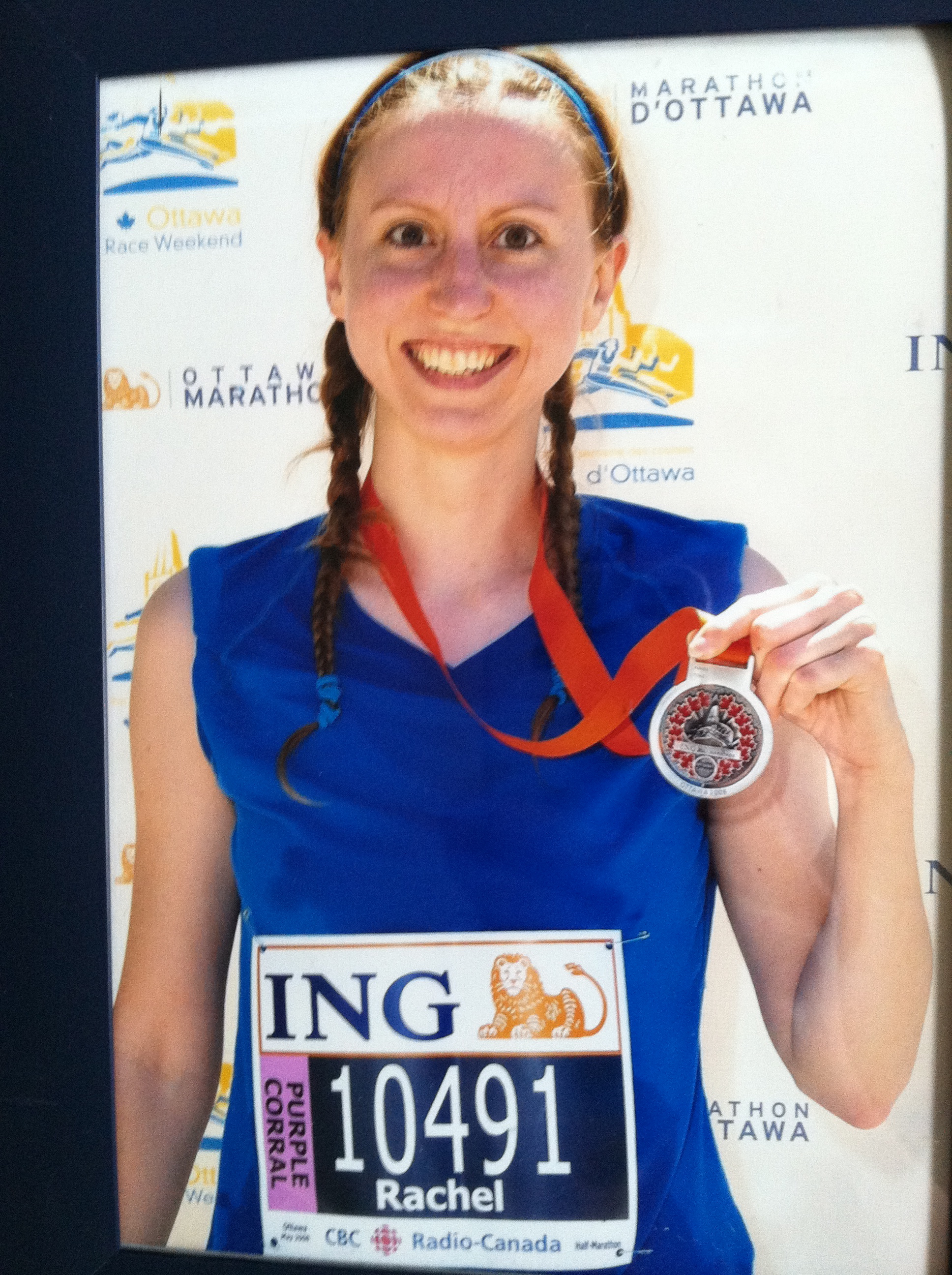
On a Sunday at the end of May 2008, I ran in Ottawa, and earned medal # 2. I ran with the Canadian National Army. I may have just has casts sawed off 5 days, prior, but by the second race, I had already caught the bug. I was a runner, and continuously trying to push myself, even coming off an injury.

The race itself was quite challenging. The weather conditions were reminiscent of Chicago 2007 – the year that lives in infamy as every runner’s nightmare when the temperatures hit unprecedented highs, runners died or were hospitalized, and the race was canceled in the middle of the race. The same thing happened that following spring in Ottawa. There were unprecedented and unplanned for highs that made the race that more difficult. The race organizers actually ran out of water and had to water us down with garden hoses not only the last few miles, but also in the runners only area after crossing the finish line. Luckily, the spectators were smart lifesavers. Many of the children had super soaker water guns they were spraying us with and some amazing spectators brought buckets of sponges in water. Running with sponges was a godsend in that race.

What I did not realize at the time I ran Ottawa or even immediately after, was that not only was I able to run Ottawa and obtain my second medal after a challenging injury, but I also ran a Boston qualifying time. Boston qualifying times are only good for two years. I had gotten an email saying that my time was only good for one more year, and that was the first I had heard or realized how well I ran.

I later went on to earn my Boston Athletic Association medal in 2010.

Ottawa taught me very early on in my running career that if you have your heart set on something, you could literally overcome almost anything to accomplish it. This is a lesson that has always stayed with me, and contributed to some other weird and off-the-wall feats in which I have engaged over the years since that race. Ottawa was the race that proved to me that marathon runners really are made in the training, not just one day when you race. It was the race that taught me that what happens in the middle is when you learn the most about yourself. It taught me that start lines are just as important as finish lines.

Your first race shows you that you are able to do the impossible. Only about 1% of the population will ever run a marathon. It is in subsequent races that you learn so much more – about who you are as a person, and what runners and spectators as a community are really all about.

Since overcoming two broken arms to run Ottawa, I have also overcome a knee injury that almost put an end to my running career, I have ran while fighting lymphoma, I have ran while dealing with multiple food allergies, I have ran through death, undergrad, grad school, falling in love, and happy tears. I have overcome so much through my running that Ottawa was really just the beginning.

Today, on Rewind Real Slow, we #TBT to medal # 2.

Whether it’s your first race or your 20th, each race and every runner has a story. Find yours.

The Insanity of Taper Mode

IMG_9734

The last three weeks of every marathoners training plan are not only challenging, but also crucial. Taper mode is that point at which your body is fully trained and prepared to go the distance of 26.2 miles long on race day, but your brain does not agree. To complicate this process, your training plan now says that you are supposed to decrease your mileage, rest, eat, and hydrate well in preparation for race day.

This seems to make total sense until you actually reach the point in the training plan where you enter Taper Mode and your brain screams: “Nooooooo. Noooooo. We’re not ready! We can’t do this! We must run more! I am not ready for the start line!”

To which your body responds: “Chill. We got this. We ready. We trained. Now is time to rest and gather our stores of glycogen and other nutrients to be able to perform.”

Yes, you are, in fact ready to race.

Your brain is not going to hear that. Your brain is not going to believe. Taper mode is called “the insanity of taper mode” because this is the point at which even the most psychologically robust completely loses their mind.

You develop OCD. You tell everyone you live in a bubble and to not touch you.

You’re like the llama in the Emperor’s New Groove telling everyone to not touch you.

The last few weeks before a marathon, you are also at your most vulnerable, immune wise. You sanitize everything like an air lock on a spaceship. Then you sanitize it again. You sanitize so much you should buy stock in soap and baby wipes.

Your training plan for Taper Mode says 6 miles. You cheat. You run 8 miles instead.

You panic. You pray. You make deals with both God and the Devil and anyone else who seems like they may be able to help you in any way. Your brain is on full-out psychotic freak out mode because it just realized you are about to run a MARATHON and that is 26.2 miles long. It’s way different from those Netflix marathons you’ve been doing to try to cope with Taper Mode.

All you need to do is make it to the start line healthy and strong. If you can make it to the start line, your body will do the rest. The start line is just as important as the finish line. In order to complete a marathon, you must cross both.

You start reading inspirational quotes, books, blogs, magazines, and watching inspirational movies to try to get yourself over the hump. You start imagining worst-case scenarios. You mentally prepare for this race better than some cult about to eat the pudding before the Hale Bopp comet. Run, walk, crawl, drag, or if in Philly, IN DRAG, you will cross the finish line. You imagine every single possible way and scenario to finish 26.2 miles because your brain does not think you are ready. You break it up into chunks: it’s a 5k with a 23 mile warm up, it’s a 10k with a 20 mile warm up, and any other chunk you can break down.

Meanwhile, your body is relaxed. Your body knows. Every fiber of every muscle in your body has been trained. The imprint of the 500+ miles you have run in the 5 months it took to prepare for the race are ingrained in your muscles. Your body knows what to do.

Your brain needs to get it together.

Calm down, man.

It doesn’t matter if it is your first time, your 20th, or your 50th, Taper Mode always feels this way. For me, I am going for medal # 14. Taper Mode is always the same. Your body is ready, and your brain is completely freaked out. You have followed the training plan, and the training plan has worked 13 times before. You will be fine.

But honestly, the insanity of taper mode makes the marathon that much more beautiful. When you lace up on race day, cross the start line, and get into the rhythm of the race, you will find that moment where your brain finally agrees with your body and calms down: “We got this.” That moment, when everything clicks into place, you just fly like you are on cruise control, and enjoy the moment for which you have spent a significant amount of your year preparing to do. That is the moment of marathon magic.

So while the insanity of taper mode is sure to be annoying and drive everyone crazy, in some ways it is necessary. Being able to appreciate how far you have come and everything you have OVERcome to get to this point is part of the marathon magic. The miracle is that you had the strength, the discipline, and the fortitude to train for those 5 months. This is for the Sunday morning long runs when you would have much rather stayed in bed and listened to the radio, this is for all the times when you ran in the pouring rain because you had to get the miles in, and a treadmill would have been worse punishment than anything mother nature can muster.

To run a marathon, you have to go a little crazy.

“But I’m not ready,” says brain.

“Yes, we are,” says body.

“We will start and we will finish,” says heart.

The Lead of Love

IMG_5458IMG_6088

This is the monthly Feline Friday post on Rewind Real Slow.

“We die containing the richness of lovers and tribes, tastes we have swallowed, bodies we have plunged into and swum up as if rivers of wisdom, characters we have climbed into as if trees, fears we have hidden in as if caves. I wish for all this to be marked on my body when I am dead.” – Michael Ondaatje, The English Patient

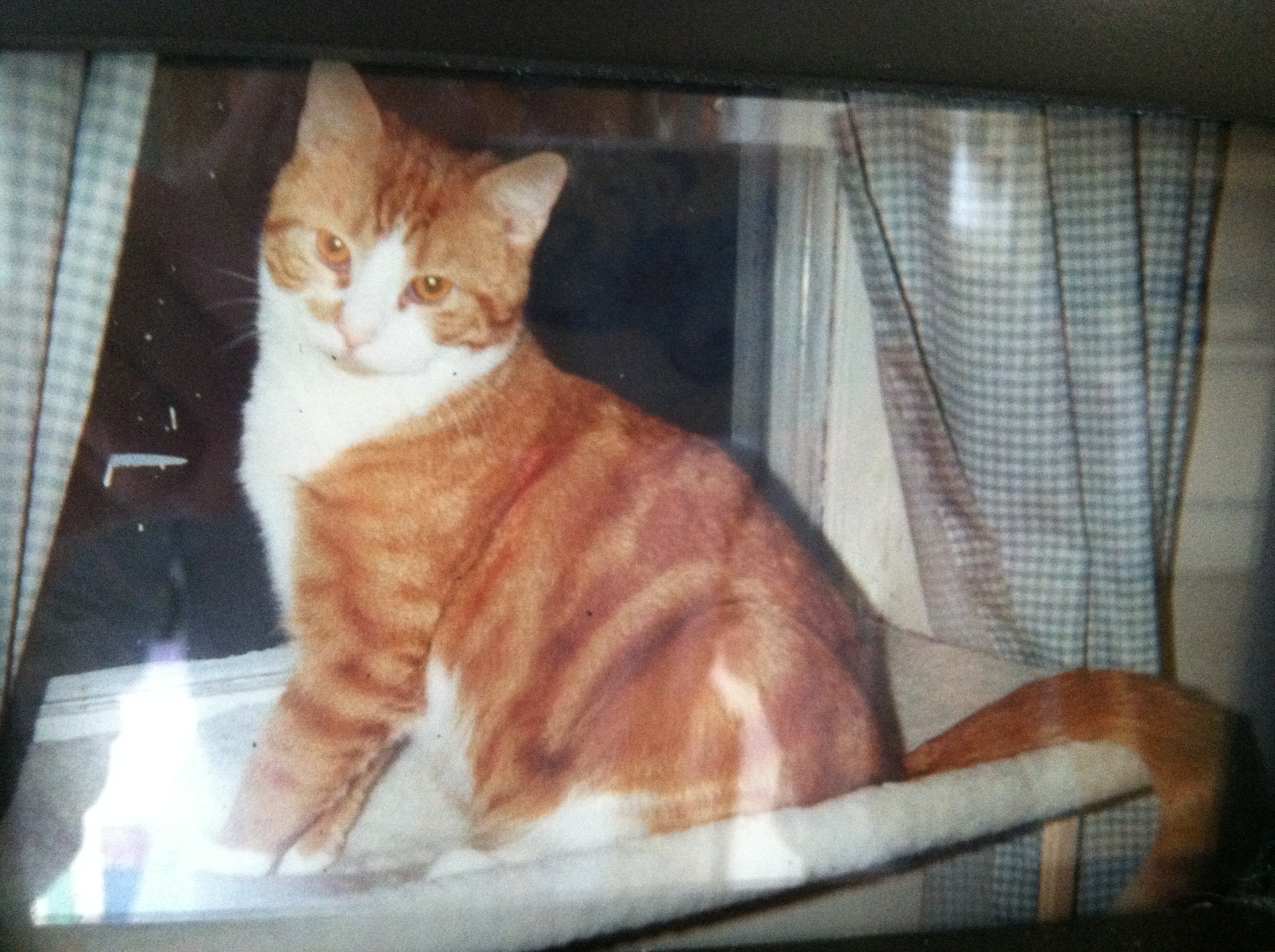
About a week after Kitty’s first birthday, Kip walked into our lives. Literally. I had seen this scrappy little orange kitten running around the neighborhood. At the time in the late 90s, Kitty and I had housing, but it was in one of the most drug and crime ridden neighborhoods in a 60-mile radius. I was on my evening walk and saw this little orange kitten on the side of the road, obviously quite hurt. A car had hit him. I tried to find his owners, but no one seemed to claim him or even to care. Not wanting to be accused of cat napping, I talked to him, and he literally followed me home.

So small that he fit inside of a child’s shoebox, I took him to the animal hospital, where he remained for a week. He had a broken arm with permanent nerve damage resulting, as well as severe internal injuries to his side and kidneys. Even after a week in the hospital, he came home with tubing in his side that required me to keep moist and flush with fluids to remove toxins multiple times daily. Due to his size, I had thought he was only a few weeks old. According to dental analysis done by the veterinarian, he was actually 4 months old, his stature diminished by severe malnourishment and neglect.

I already had a Kitty at home, and I did not want to traumatize the orange treasure by renaming him and instituting an identity crisis. I was searching for something close to Kitty (as almost all cats will respond to kitty) that was not kitty; he needed unique nomenclature to fit his persona. I borrowed a name from one of my favorite movies and novels. Kip Quark Anderson had entered our lives.

What I did not realize at the time was how appropriate this name would be to his place and impact upon our lives. Kip was the apple, the joy, and the love of Kitty’s and my life. We had 14 wonderful, beautiful, glorious years together, many of them spent regulating his resulting chronic kidney condition, before he finally succumbed to pancreatitis a few years ago.

Kip was a happy go lucky, playful cat full of joy. He taught Kitty how to not be so uptight, how to relax, how to play. Everyone who met Kip loved him. Kip was leash trained and quite enjoyed walking on a leash, often emulating a dog. He was a frequent visitor to my preschool classroom, where he never failed to delight, entertain, and draw out even the most shy and precarious child in the class.

He handled his chronic health condition with grace and dignity. The nightmare-ish visions of having to “pill a cat” never happened with Kip. I would set his medication on his plate with his breakfast or dinner, and he would happily eat it the same as his food. Towards the end of his life, he was on 5 different medications daily, one of them by dropper, and he never squirmed or protested when it was time for his medications.

Kip kept both Kitty and I from losing our minds. Life was hard in the late 90s and early 2000s, as we faced bad relationships, and sometimes lived in the car. Kip’s attitude was always upbeat and helped to remind Kitty and I of the brighter side of life, that things do in fact, get better. Of all my kids, Kip is probably the one who most taught me how to adult and forced me to create a stability in my life and theirs that I had never experienced as a child. I made sure that he received all the medical care that he required and that I was home to give him his medications on time. I was even able to keep his medication on schedule during my early grad school years when I had a one-way 6-hour plus commute from Central New York to Boston for school.

I had spent my first three years of college as a physics major; The English Patient movie came out my freshman year of college. I was particularly drawn to the character of Kip, as his profession in the novel and movie was exactly what I was studying to do in college. In many ways, Kip the cat fit his namesake. He was proficient in diffusing many tense situations with his absolute love of life and easy-going personality.

What Kip taught me the most in his 14 short years on this planet was love. He taught Kitty too. He taught me that every experience, no matter how dark or dire, has a small sliver of hope. He taught me that every single person we meet in life changes us in ways we may not even see or understand. He lived a very full and very bright life that was nothing but a lead of love to everyone he met.

This month, for #FelineFriday, we honor the memory of Kip. At times in my life when I was trying to go too fast, when I was trying to accelerate at 100mph, Kip always reminded me to slow down and remember the important things. Each experience in our life changes us and stays with us forever. Kip not only led with love, but he has changed my life in ways that will have repercussions until my dying day. Even as I held him in my arms a few years ago, as he passed away, he still taught me in his final breaths, the meaning of love.

Cheers to the memory of Kip this month on Rewind Real Slow. If love could have saved you, you would have lived forever.

The Best Summer

IMG_9497

Despite the still balmy temperatures we have in September, the leaves are starting to turn, the kids have returned to school, and summer is quietly sliding into fall. Summer 2015 is the best summer I have ever had in life. I do not remember a summer like this since 1988. I tried to think about why this is so and to isolate the commonalities that seemingly exist between two so disparate years.

In 1988, I was still a child. This was before I started working at age 14. While my childhood was nothing pretty and everything I have been trying to overcome as an adult, I distinctly remember the summer of 1988 as having a slight respite from the challenges through which I lived in my youth. I remember reading lots of books. I was in Virginia that summer, and the people with whom I was staying had a pool membership. When I was not in the pool, I was next to it reading. Those were the most carefree days of my life. Granted, my tastes have changed. I did not re-read Jurassic Park and all the other Michael Crichton novels this summer, but I actually had time for leisure reading; a rare treat as a grad student.

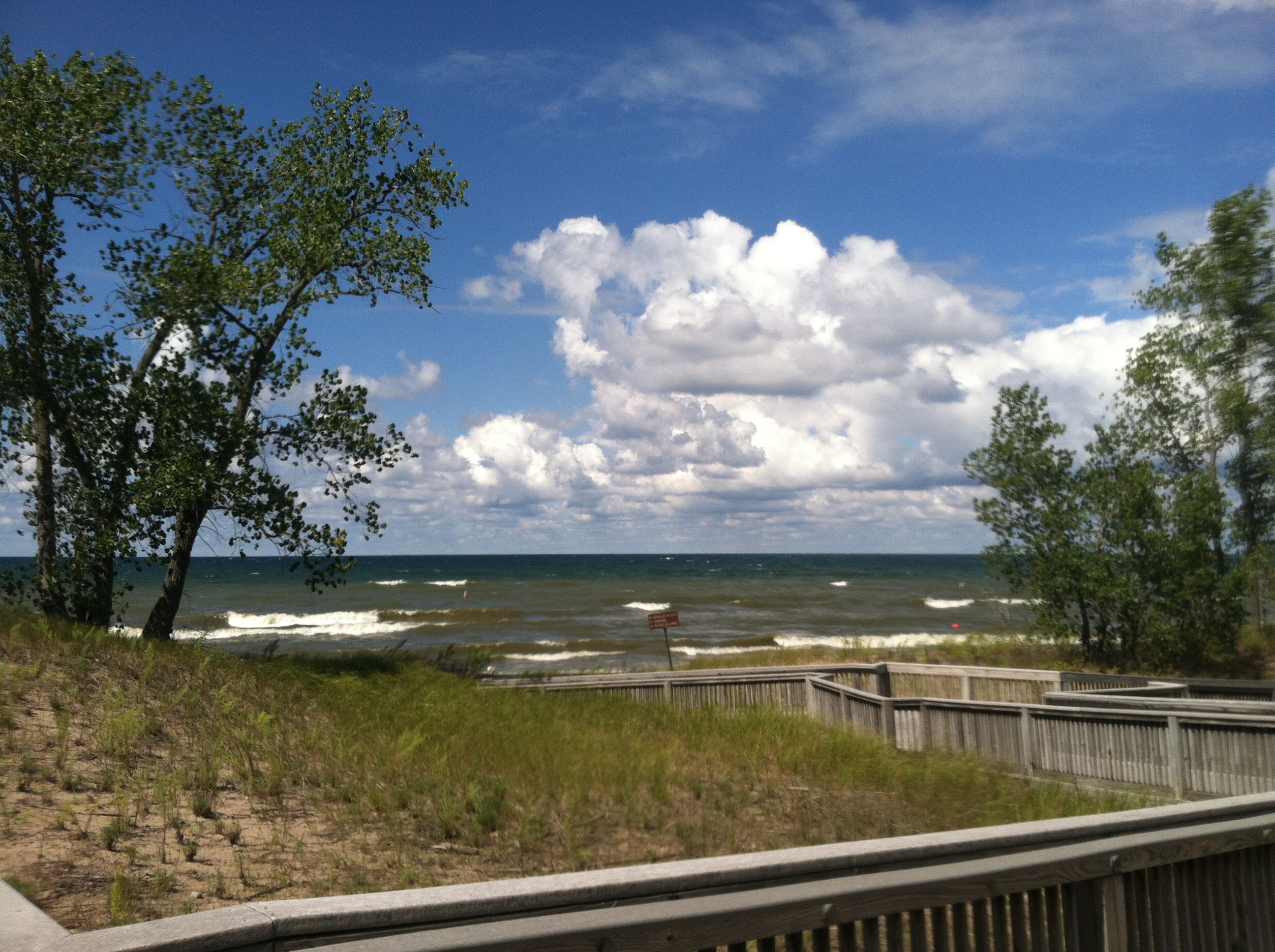
This summer, I had the gift of time. For the first time in my adult life, I have employment that actually allows me days off. Prior to my current position, I was always working 7 days a week between two or three jobs. The only time I ever got a day off was a holiday. Holidays were not really holidays, they were days to be home and get caught up on school and everything else in the middle of my 60 hour plus survival schedule. My current position gives me at least one day off per week, and often more. I had several days this summer where I had the day off and the freedom to recreate that feeling from 1988 of being free from responsibility and worry. I spent many days this summer at the various parks in the state, on the beaches reading, and doing some light surfing.

Beach days were not relaxing at first. I was so accustomed to the schedule of having to pack school into every free moment due to my work schedule, that my first few beach visits I took my school work with me. Then, as I started to realize my current employment situation allows me privileges I have never before experienced in life, I made a conscious decision that I would not take any schoolwork with me.

That’s where the magic begins.

Beach days became carefree and reminiscent of that childhood summer of 1988. I simply put some food in a cooler, grabbed a towel, a book, and some sunglasses, and off I went. The most “difficult” decision I had to make was which bathing suit to wear, and even that was not hard: wear the dry one that is in the closest reach.

This summer was great because it was probably the first time since I started working at age 14 that I actually had “holidays.” Now I know what the Europeans are talking about. I took off for beach days this summer without school, without work, and without worries. That has never happened for me before.

In some aspects, I feel I was able to reclaim some small portions of my childhood lost due to the difficulties I faced as a child and being forced to grow up way to soon to face them. I felt a little irresponsible “blowing things off” and taking beach days, but in reality, all my work and schoolwork was done, and my bills were paid, so really I was not blowing anything off, I was doing the best thing possible. I was taking care of myself. I was able to experience childhood delight that I never experienced as a child, and able to fully relax and be present in the moment in which I was living. It was one of the best things I have ever done.

As summer slowly changes to fall, I feel I am also losing that feeling. I feel I need to recreate it somehow, so that I do not lose the beauty of my summer beach days. What I am learning, as I rewind real slow, is that peace and relaxation may not necessarily be about your location (although beaches and crashing waves are very helpful), but rather a state of mind that says: “I am here. I am at peace.” Most importantly: “I am enough.”

I have gotten caught up in the whirlwind of fall. The anxiety of back to school (although my grad program runs continuously until its conclusion); it’s that Pavlovian response to the change in season. I find myself trying to jam pack my schedule again.

Then I realized that having the best summer of my life need not be an isolated incident. It is also possible to have the best fall of my life.

Now I’m putting on the breaks.

In the next few weeks, my goal is to refocus myself for a new season not only in weather, but also in life. I am going to remember to enjoy my days off. While I may not be spending them at the beach right now, I need to remember to not fill them with useless and unnecessary things. That beach feeling is something I can recreate in other ways. I just need to figure out how.

Do you get caught up in the fall whirlwind? Is this the time of year you pack your (or your child’s) schedule with activities, meetings, and things to do? Summer is not the only season for relaxing and joy. Fall can have the same feeling of peace if only we know how to find it.

As the breeze blows gently, I am enjoying a fall morning now on my deck with my coffee, and some radio. If this summer has taught me anything, I have learned that it is ok to just sit and be. Doing nothing is not necessarily lazy. Sometimes doing nothing helps to replenish us so that we may fully do something.

What ways are you learning to slow down this fall? Are there things that help you to feel relaxed in the middle of the bustle of back to school and new schedules? Times of transition are often stressful. This is the time when we need to take care of ourselves the most.

Take time to rewind real slow.